
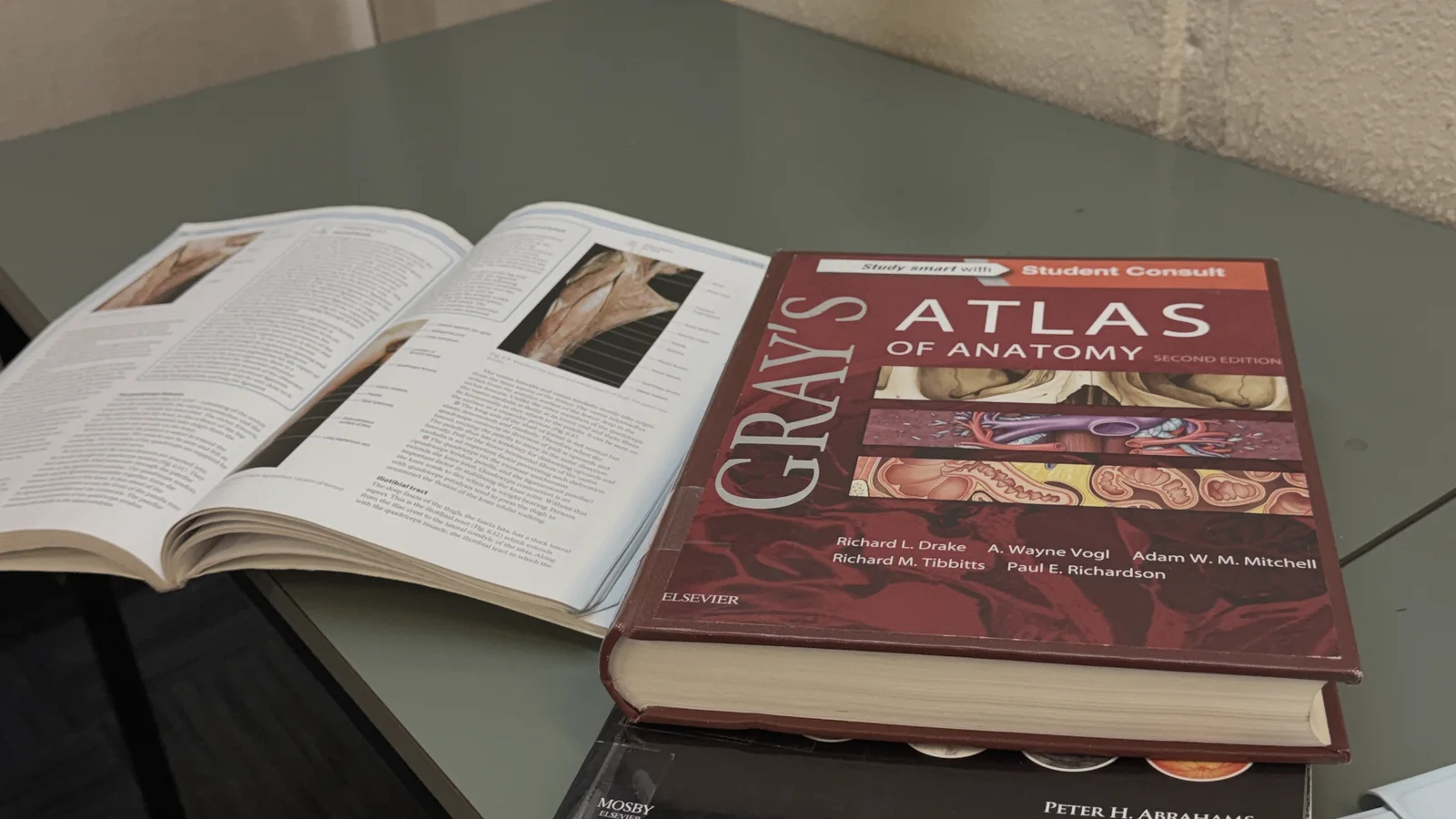
Diagram questions are won before the exam, by practising on unlabelled figures rather than studying labelled ones. In the room, the technique is to orient yourself first, then answer the question that was asked, which is often about function rather than the name.
Why studying labelled diagrams fails
Looking at a fully labelled figure is passive. Everything is already answered, so you get the comfortable feeling of recognition without ever testing whether you could produce any of it.
Anatomy is naturally dual-coded, images plus words, and pairing them helps understanding (Mayer, 2009). But you only get that benefit when you make the pairing yourself.
The practice that works
- Label from blank. Print or cover the labels, fill them in cold, then check. What you miss is your study list.
- Say the function too. For each structure you name, state what it does. HUBS questions routinely ask you to identify a structure and then reason about its role, so practising the name alone leaves you half prepared.
- Vary the orientation. You may have learned the heart from one textbook view and then meet a different section in the exam. Practise on more than one representation so you are not relying on the position of things on a familiar page.
- Trace the flow. For the cardiovascular, respiratory and renal systems, follow the path all the way through: where does this blood, air or filtrate go next. Sequences hold up far better than isolated labels.
In the exam room
- Orient before you read the options. Work out what the figure shows and which way round it is. Most panicked mistakes come from misreading the view, for example assuming left and right are your left and right rather than the body's.
- Find the labelled structure first, then read what is being asked about it. Often the question is not "what is this" but "what does this do" or "what lies immediately behind it".
- Use the surroundings. If a label is ambiguous, identify the structures around it. Anatomy is relational, and neighbours usually disambiguate.
- Answer the actual question. Identifying the structure correctly and then answering a different question about it is a classic and infuriating way to lose a mark.
- Do not talk yourself out of it. These questions are written to make you second-guess, with two options that both look defensible. If you knew it on sight, stick with it.
Where this matters most
HUBS192 is the diagram-heavy paper: cardiovascular, respiratory, gastrointestinal, renal and reproductive systems all lean on figures. HUBS191 has plenty too, particularly nervous system and joint diagrams.
Since the MCQ sections of past papers are not released, real diagram questions in the exam format are hard to come by. Our HUBS192 practice questions include labelled diagram questions with worked answers, which is the closest thing to practising the real task.
The summary
Do the generating work in advance, and in the exam slow down for two seconds to orient before you commit. Diagram questions are some of the most reliably winnable marks in HUBS, and almost all of the losses come from technique rather than knowledge.
References
- Mayer, R. E. (2009). Multimedia learning (2nd ed.). Cambridge University Press.