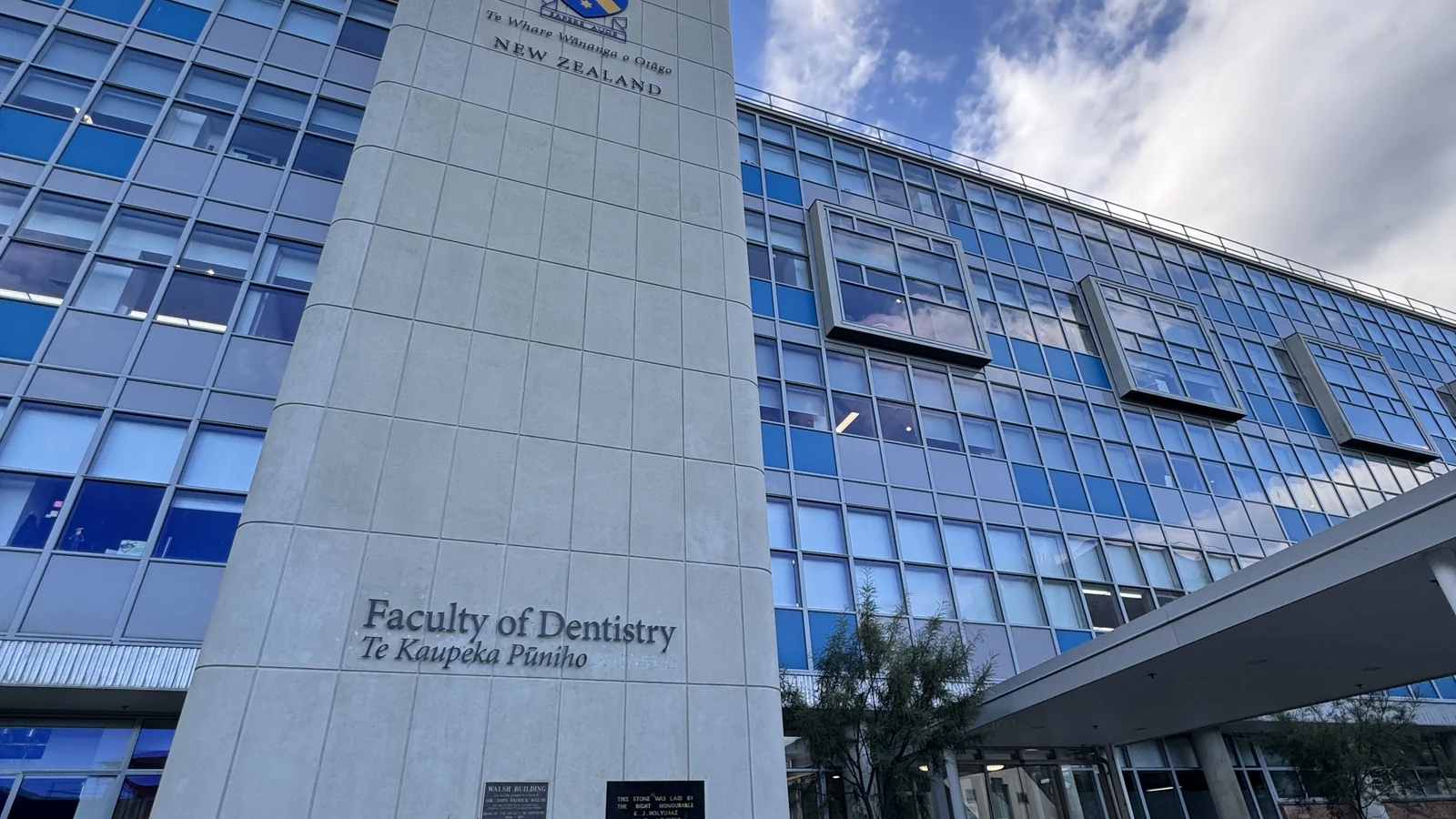

There is one dental school in New Zealand. It takes 60 domestic students a year, it stopped using the UCAT in 2024, and in 2026 it was harder to get into than medicine on raw marks. Most guides you will find online still say the opposite of all three.
This is how entry to Otago Dentistry works, with the numbers Otago publishes itself. Every figure is sourced and dated, because these rules change yearly and the out of date version of them is what most of the internet is serving.
The short answer
You cannot apply to dentistry from school. You do Health Sciences First Year at Otago, sit the seven prescribed papers, apply during that year, and you are ranked on your marks. There is an interview, but it is a gate you pass or fail rather than a score that lifts you up the list.
The Bachelor of Dental Surgery is five years, all of it in Dunedin, and Otago is the only place in the country that teaches it.
Auckland does not have a dental school
Worth saying plainly, because the phrase "dentistry at Otago and Auckland" turns up constantly and it is simply wrong. Auckland has a medical school. It has no undergraduate dental degree. If you want to be a dentist trained in New Zealand, the Faculty of Dentistry in Dunedin is the only door, which is a large part of why the numbers below look the way they do.
Otago dropped the UCAT for dentistry
This is the single most out of date fact in the New Zealand dentistry SERP. Otago removed the UCAT requirement from all dentistry admission categories in 2024, effective for the 2025 intake onwards. Otago's own changes page states it, the dentistry guidelines page does not mention the UCAT once, and the UCAT ANZ consortium lists Otago for Medicine only.
So if you are applying to dentistry and nothing else, you do not need to sit the UCAT. If you are applying to both medicine and dentistry, you do, because medicine still requires it. That is the rule, and paying for a UCAT preparation course on the strength of a guide written in 2023 is a real cost people are still incurring.
What Otago requires
The 65 percent average, and the 60 percent floor
Dentistry has one eligibility condition medicine does not, and it catches people out every year.
| Requirement | Medicine | Dentistry |
|---|---|---|
| Average across your best seven papers | At least 65 percent | At least 65 percent |
| Minimum mark in any single prescribed paper | A pass | At least 60 percent |
| UCAT ANZ | Required, as a threshold | Not required at all |
| Interview | None in the school leaver route | Yes, and everyone shortlisted sits one |
Read that second row carefully. One paper at 58 percent makes you ineligible for dentistry while leaving you perfectly eligible for medicine, on the same transcript, in the same year. If dentistry is your first choice, a single weak paper is not something you can average your way out of.
The interview is a gate, not a score
Around 350 applicants across all categories are invited to interview. It runs by Zoom in late September or early October, and the panel assesses motivation, decision making and communication.
Here is the part that changes how you should think about it. Otago states that after meeting the interview threshold, interview performance is not given weight in the further selection process. You cannot interview your way up the ranking. You can only fail to clear the bar. Final selection is on academic ranking.
That is not a reason to wing it. It is a reason to prepare enough to pass comfortably and then put the rest of your time into your marks, because your marks are the entire ranking.
How the academic score works
Exactly as for medicine: the plain mean of your best seven paper marks as percentages, no weighting, no 4.0 grade point scale. The optional eighth paper counts if it lands in your best seven.
The numbers, and the thing nobody tells you
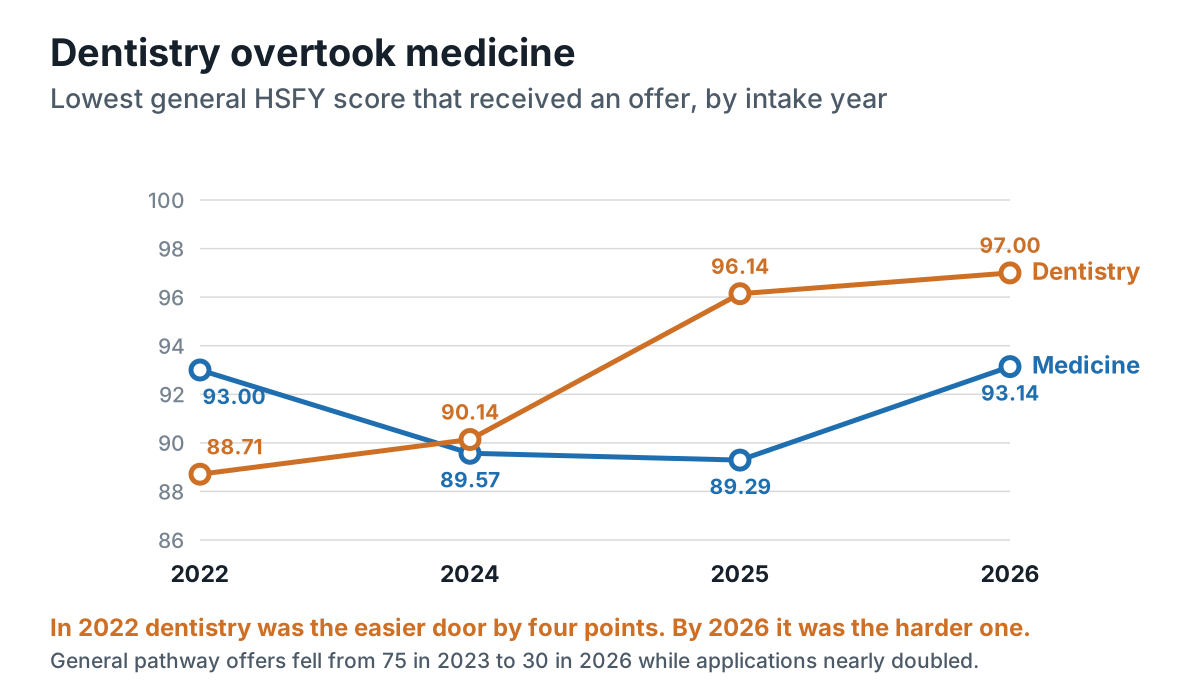
Dentistry is now harder to get into than medicine
This surprises almost everyone, including people already in health sci.
| Intake year | Lowest successful score, Dentistry | Lowest successful score, Medicine |
|---|---|---|
| 2022 | 88.71 | 93.00 |
| 2024 | 90.14 | 89.57 |
| 2025 | 96.14 | 89.29 |
| 2026 | 97.00 | 93.14 |
General HSFY pathway, lowest average academic score that received an offer. In 2022 dentistry was more than four points easier. By 2026 it was nearly four points harder.
Why it moved
Two things happened at once, and both are in Otago's own statistics report.
| Intake year | Applications, all categories | Admissions | General HSFY offers |
|---|---|---|---|
| 2022 | 530 | 66 | not published |
| 2023 | 596 | 86 | 75 |
| 2024 | 674 | 90 | 61 |
| 2025 | 889 | 93 | 48 |
| 2026 | 1,032 | 101 | 30 |
Applications roughly doubled in five years. Meanwhile the general pathway HSFY offers fell from 75 to 30. More people competing for fewer general places is the whole explanation, and it is why the line went up almost nine points in three years.
Note that total admissions went up over the same period, from 66 to 101. The squeeze is specific to the general HSFY pathway, not to dentistry overall.
What this does not mean
It does not mean dentistry will be harder than medicine next year. The line lands wherever that year's applicants put it, and it has swung by eight points in four years. Anyone giving you a target number for 2027 is guessing, and Otago will not publish the 2027 figures until around March 2027.
How many places, and who gets them first
Sixty domestic places for 2027, across every admission category. As near as possible to 70 percent of those go to the HSFY category, with the balance shared between Graduate and Alternative.
Otago selects equity group applicants first, in a published order: Māori, Resident Indigenous Pacific, Refugee Background, Socioeconomic Equity, then Rural, before general applicants. Quotas are not published, by design. The score ranges Otago does publish for these pathways are outcomes rather than targets, and any figure covering fewer than five people is suppressed.
If you are eligible for one of these pathways, begin the verification early. It is a separate process with its own evidence requirements and it is not a form you fill in the week applications close.
If you already have a degree
Otago runs a Graduate category for dentistry, ranked on a weighted GPA where 100 level papers count 0.5, 200 level 1.0 and 300 level 1.5. Otago publishes a calculator for it, and there is a new weighted GPA calculation from the 2027 intake onwards, so make sure you are using the current one.
Graduate applicants interview too. For 2026, 79 graduate general pathway applicants were invited.
The dates
- Applications opened 1 July 2026 and closed 13 August 2026.
- Interviews are held by Zoom in late September or early October.
- Outcomes are released by 18 December.
- No late applications are accepted.
- New for 2027: if you apply for both Medicine and Dentistry you must nominate a preferred programme.
Check the current year's dates on Otago's own page. They move.
Common questions
Does Otago dentistry require the UCAT?
No. Otago removed the UCAT requirement from all dentistry admission categories in 2024, effective from the 2025 intake. You only need it if you are also applying to medicine.
Is dentistry easier to get into than medicine in New Zealand?
Not any more. For 2026 entry the lowest successful general HSFY score was 97.00 for dentistry against 93.14 for medicine. In 2022 it was the other way round. General pathway offers fell from 75 in 2023 to 30 in 2026 while applications nearly doubled.
Can you study dentistry at Auckland?
No. Otago is the only university in New Zealand that offers the Bachelor of Dental Surgery. Auckland has a medical school but no dental degree.
What is the minimum mark for dentistry at Otago?
An average of at least 65 percent across your best seven papers, with no prescribed paper below 60 percent. That is eligibility, not competitiveness. The lowest score that received a general pathway offer in 2026 was 97.00.
How many places are there?
Sixty domestic places for 2027, across all categories, with about 70 percent of those going to the Health Sciences First Year category.
How to prepare
For dentistry the honest advice is unusually simple, because the ranking is unusually simple. Your marks are the ranking. The interview is a gate, the UCAT is not used, and there is nothing else in the formula. Seven papers, and the 60 percent floor means you cannot afford to write one of them off.
Cutline is built by Otago medical and dental students for those seven papers. Question banks and timed mock exams for each one, with the first mock free so you can judge it before deciding anything.
If you are starting first year, Cutline Summer runs from mid November to the end of February and covers the first year papers before you sit them. Enrolment opens 2 November 2026, and the waitlist and application are both free and open now.
Cutline is not affiliated with the University of Otago. Every figure on this page comes from Otago's own admissions pages and its published Dentistry Admissions Statistics, read on 17 September 2026. Admissions rules change every year, so always check the official page for the year you are applying in.