

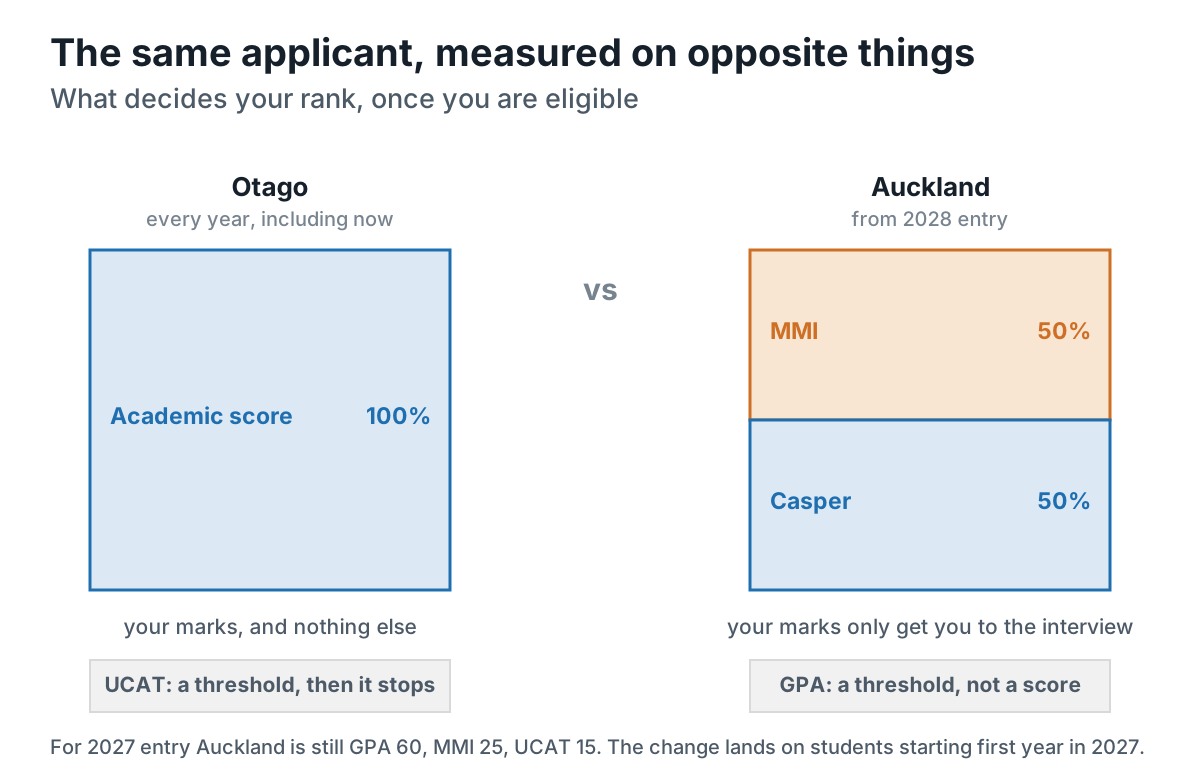
Otago and Auckland both take you from a first year into medicine. They are about to select on almost opposite things. Otago ranks you on your marks and nothing else. Auckland, from 2028 entry, ranks you on an interview and a situational judgement test, with your marks reduced to a threshold you either clear or do not.
So the year feels different, you practise different things, and it suits a different kind of person. If you're choosing between them, here's how the two line up side by side.
The one table
| Otago | Auckland | |
|---|---|---|
| First year | Health Sciences First Year, seven prescribed papers | BHSc or Biomedical Science, widening to nine programmes from 2028 |
| What decides your rank | Marks, 100 percent | 2027 entry: GPA 60, MMI 25, UCAT 15. 2028 entry: MMI 50, Casper 50 |
| Admissions test | UCAT, as a pass or fail hurdle only | UCAT for 2027 entry, then Casper from 2028 |
| Interview | None in the school leaver route | Eight station MMI, seven assessed |
| Your GPA | Is the ranking | From 2028, a threshold. Clear it and it stops counting |
| Domestic places | About 322 for 2027 | 317 |
| Dentistry from the same year | Yes, the only dental school in the country | No dental school |
The year-numbering trap, before anything else
Auckland's announcement says the change applies "from 2027". That means the 2027 application year, which is entry in 2028. Auckland's own release settles it: students applying for clinical programmes starting in 2027 are not affected.
So if you are applying during 2026 for a 2027 start, the old weighting still applies to you. If you begin first year in 2027, you are the first cohort under the new rules. Getting this backwards means preparing for the wrong test for a year, which is why it leads this post rather than sitting in a footnote.
What each one asks of you
Otago asks you to be excellent at seven exams
Your academic score is the plain mean of your best seven paper marks. No weighting, no interview, and once your UCAT clears the thresholds it stops counting entirely. A 2,600 and a 2,000 that both clear are worth the same.
The upside is that it is legible. You know exactly what you are being measured on and you can practise it directly. The downside is that there is nowhere to hide and no second component to rescue a bad semester, and the line moves: the lowest successful general pathway score went 93.00, then 89.29, then 93.14 across recent years, because it lands wherever that year's applicants put it.
Auckland, from 2028, asks you to be good in a room
Clear the GPA threshold and no grade below a B, and from there your rank is decided half by an eight station MMI and half by Casper. You can't cram for either of them. Both test judgement, communication and reasoning under time, and you get better at them by practising out loud.
The upside is that a strong communicator is no longer capped by being the fourth best marks in the room. The downside is that it is much harder to self-assess. You can know your BIOC192 mark. You cannot easily know how you come across in a three minute station.
Which suits you
Most people should choose on other things: where you want to live for six years, the cost, whether you want dentistry on the table, whether you have people near you. It's worth knowing how each one selects, but don't plan your life around it, because both change and the method you plan for in Year 12 may not be the one you meet.
That said, two real signals:
- If exams are your strength and interviews frighten you, Otago's method rewards exactly what you are good at, and there is no interview at all in the school leaver route.
- If your marks are good but not exceptional, and you are strong with people, Auckland from 2028 gives you a route that Otago structurally does not, because at Otago there is nothing beyond the marks.
And the one that decides it for some people regardless: dentistry only exists at Otago. If dentistry is on your list, Auckland cannot offer it. See how to get into dentistry in New Zealand.
You are not locked in at seventeen
The choice feels enormous at the time, but both universities run graduate categories, so a degree elsewhere is a real second route. From 2028 there is also Waikato's graduate entry MD, which selects on GAMSAT rather than UCAT and is a third door that did not exist when most of the guides you are reading were written.
The route you cannot repeat is Otago's HSFY category, which is once only. Everything else has a way back.
Common questions
Is it easier to get into medicine at Otago or Auckland?
Neither is easier, they are hard in different ways. Otago admitted 347 from 1,141 applications for 2026, about 30 percent. Auckland received 1,718 applications for 317 domestic places. Otago concentrates everything into your marks; Auckland, from 2028, concentrates it into an interview and Casper.
Can I apply to both?
Yes, but they are separate applications from separate first years. You do one qualifying year, at one university, and apply from inside it. You cannot sit HSFY at Otago and a BHSc at Auckland in the same year.
Does Auckland have a dental school?
No. Otago's is the only one in New Zealand. Auckland has a medical school and no undergraduate dental degree.
Which first year is harder?
They are comparable, and the difference is what happens to the marks. Both are first year science in a cohort of people who were near the top of their school. At Otago every mark goes into your ranking. At Auckland, from 2028, clearing the threshold is what the marks are for.
Is HSFY the same as Auckland's BHSc?
No, and they are not interchangeable. HSFY is Otago's seven paper first year and exists only there. Auckland's Bachelor of Health Sciences is a full degree and Auckland's own route into medicine. Otago also has a separate Bachelor of Health Sciences, which is a third thing again.
How to prepare
So the two need different practice.
For Otago, it is the seven papers and the ability to sit them under time. Cutline has question banks and timed mocks for each one, with the first mock free.
For Auckland from 2028, it is the room. Cutline's MMI simulator runs real Auckland style stations with per station feedback, which is the part you cannot practise by reading. Note that this is an Auckland product: Otago does not run an MMI, and a guide telling you to prepare for one is describing Auckland.
If you are starting first year either way, Cutline Summer runs from mid November to the end of February and covers the first year papers before you sit them. Enrolment opens on 2 November 2026, and the waitlist and the application are both free and open now.
The full detail on each route is in how to get into medicine in New Zealand.
Cutline is not affiliated with the University of Otago, the University of Auckland or the University of Waikato. Every figure on this page comes from those universities' own published admissions pages, read on 17 September 2026. Admissions rules change every year, so always check the official page for the year you are applying in.