
You cannot apply to medical school in New Zealand from high school. You apply after one qualifying year at university, and that single year decides almost everything. There are three medical schools, they select in completely different ways, and one of them has just thrown out the admissions test it used for a decade.
This is the whole pathway, with the real numbers Otago and Auckland publish and almost nobody quotes. Every figure below is sourced from the universities themselves and dated, because entry rules change every year and most of the guides you will find were written for a system that no longer exists.
The short answer
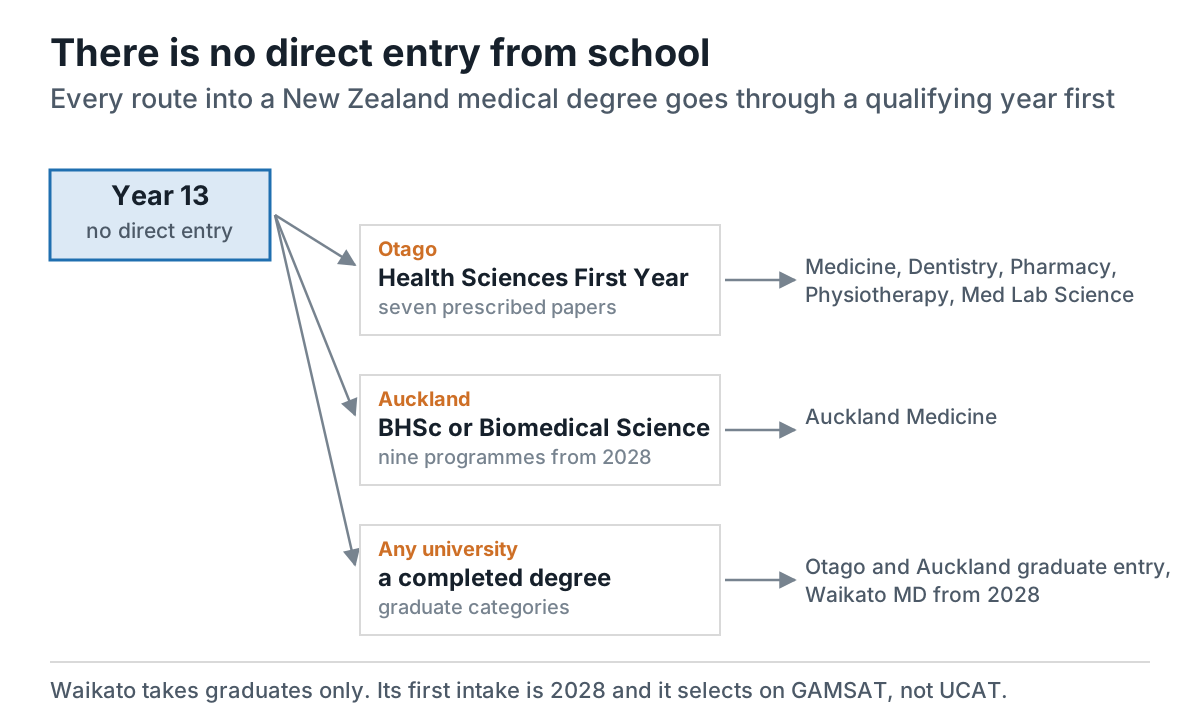
You enrol in a qualifying first year, sit a set of prescribed papers, and apply during that year for entry the following February. At Otago that year is Health Sciences First Year. At Auckland it is the Bachelor of Health Sciences or Biomedical Science. Waikato takes graduates only and opens in 2028.
What gets you in depends entirely on which school you are applying to, and the two established schools could hardly be more different. Otago ranks you on your marks and nothing else. Auckland is about to rank you on an interview and a situational judgement test, and not on your marks at all.
New Zealand has three medical schools now
Most guides still say two. A third was funded and is under construction.
| School | Entry point | Admissions test | Interview | Domestic places |
|---|---|---|---|---|
| Otago MB ChB | After Health Sciences First Year, or as a graduate | UCAT ANZ, as a threshold only | No, not in the school leaver route | About 322 for 2027 |
| Auckland MBChB | After a qualifying first year, or as a graduate | UCAT for 2027 entry, Casper from 2028 entry | Yes, an eight station MMI | 317 |
| Waikato MD | Graduates only, first intake 2028 | GAMSAT, not UCAT | Not yet published | 120 at first intake |
Waikato matters even if you are in Year 13 now. Applications open around the middle of 2027 for a 2028 start, and it is a graduate programme, so it is a genuine second route rather than a competitor for your school leaver application. Its entry requirements have not been published while accreditation is in progress.
You cannot apply to medicine from school
This is the single most common misunderstanding, and it causes real damage because students shape their Year 13 around the wrong thing. There is no direct entry to a New Zealand medical degree from secondary school. You apply to a first year programme, and you apply to medicine from inside it.
The Otago route
Health Sciences First Year is seven prescribed papers across two semesters. Semester one is CELS 191, CHEM 191, HUBS 191 and PHSI 191. Semester two is BIOC 192, HUBS 192 and POPH 192. You may add an optional eighth paper in semester two, and if it lands in your best seven it counts.
HSFY leads to more than medicine. Dentistry, Pharmacy, Physiotherapy, Medical Laboratory Science and several others select from the same year, and five of those programmes have an HSFY entry category.
The Auckland route
Auckland selects from a qualifying first year in the Bachelor of Health Sciences or Biomedical Science. From 2028 entry the list of eligible first year programmes widens considerably, from two programmes to nine, including a new Bachelor of Biomedical Science, refreshed BHSc majors and six BSc health majors.
Your Year 13 subjects matter less than you think
There are no subject prerequisites for entry to Health Sciences First Year. Otago strongly recommends Chemistry, Physics and Calculus, and that recommendation is worth taking seriously because the first semester assumes them. But recommended is not required, and almost every guide states the recommendation without stating that distinction, which causes avoidable panic in Year 12.
What Otago actually requires
The seven papers and the 65 percent rule
To be eligible in the HSFY category you must be enrolled in all seven prescribed papers in the year you apply, pass all of them, and average at least 65 percent across your best seven. You must not have previously completed that set of seven in a single calendar year, and you may apply in this category once only.
UCAT is a hurdle, not a score that counts
Otago requires a UCAT ANZ result in all four domains, and sets percentile thresholds annually. For entry to the 2027 programme the thresholds were the 20th percentile or above in Verbal Reasoning and the 10th percentile or above in Situational Judgement, with the committee explicitly reserving the right to apply thresholds in the other domains later.
Here is the part that changes how you should prepare. Once you clear those thresholds, your UCAT score stops mattering. Otago states that after the eligibility threshold is met, UCAT scores are not given weight in the further selection process. A 3,000 and a 2,400 that both clear the thresholds are worth exactly the same to your Otago application.
How the academic score is worked out
It is a plain average. Your academic score is the mean of your top seven paper marks as percentages. No paper is weighted more heavily than another, and there is no 4.0 grade point scale involved. Otago's own worked example takes eight papers of 93, 86, 82, 77, 75, 72, 72 and 70, drops the 70, and divides 557 by seven to reach 79.57.
There is no interview for the school leaver route
Otago does not interview HSFY category applicants to Medicine at all, and it does not run a multiple mini interview for them. Interviews exist in the Alternative category, and Dentistry interviews every shortlisted applicant, but for the ordinary Otago medicine pathway the final determining factor is academic score. If a guide tells you to prepare for an Otago med MMI, it is describing Auckland.
The rules that catch people out
- One application only in the HSFY category, ever.
- All seven papers must be passed at first attempt.
- New for the 2027 intake, if you apply for both Medicine and Dentistry you must nominate a preferred programme.
- Also new for 2027, pre-Christmas Summer School papers are excluded from the weighted GPA, which has a sharp edge: needing one to finish your degree can make you ineligible.
- You must pass the HSFY English Diagnostic or ENGL 128. People forget this one every year.
What Auckland actually requires, and what is about to change
Auckland has inverted its selection. This is the most important current fact in New Zealand medical admissions and it is not yet reflected in most published guides.
The year numbering trap
Auckland's announcement says the change applies "from 2027". That means the 2027 application year, which is entry in 2028. Auckland's own release resolves it: students applying for clinical programmes starting in 2027 are not affected. So if you are applying during 2026 for a 2027 start, the old rules apply to you. If you start first year in 2027, you are the first cohort under the new ones.
2027 entry, the current rules
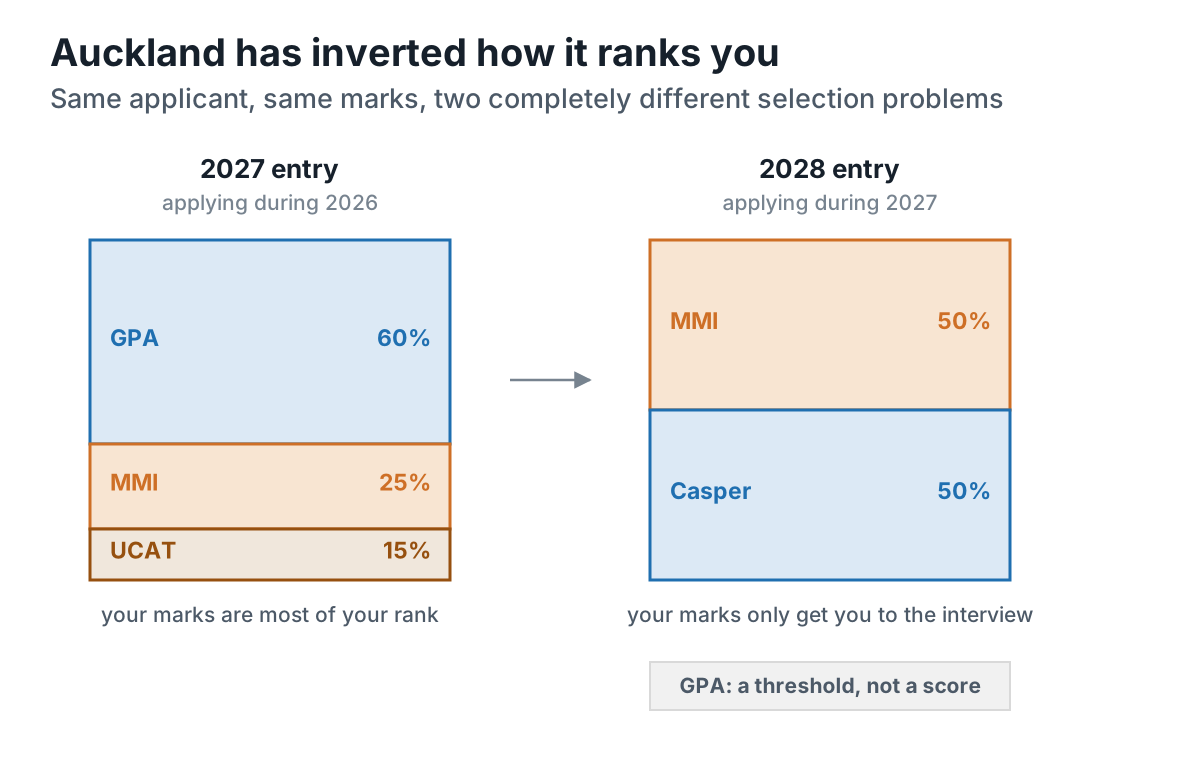
Ranking is a composite: 60 percent GPA, 25 percent MMI, 15 percent UCAT, combined as z scores. You need a GPA of at least 6.0 to be considered.
2028 entry, the new rules
UCAT is gone. GPA is demoted from 60 percent of your rank to a threshold you either clear or do not. The ranking becomes 50 percent MMI and 50 percent Casper, the situational judgement test from Acuity Insights.
There is also a new rule that no grade may fall below a B in any of the eight first year courses, and CHEM 110 is replaced by CHEM 190.
What this means practically: for Auckland, from 2028, your marks buy you a ticket to the interview and nothing more. The ranking is decided by how you perform in an interview room and on a situational judgement test. That is a completely different preparation problem from the one Otago sets.
Inside the Auckland MMI
Eight stations, seven of them assessed, 30 seconds to read and three minutes to answer, scored out of 30 per station and fair scored using a many facet Rasch model. It runs through Kira Talent as a single simultaneous national sitting, and since 2026 it has been asynchronous.
The real numbers
This is the section almost no guide will give you, because it takes reading the universities' own statistics reports rather than repeating what other guides say.
How many apply, and how many get in
| Otago intake year | Applications | Admissions |
|---|---|---|
| 2022 | 1,003 | 293 |
| 2023 | 928 | 289 |
| 2024 | 960 | 322 |
| 2025 | 943 | 338 |
| 2026 | 1,141 | 347 |
So roughly one in three. For the 2026 intake Otago admitted 347 from 1,141 applications, about 30 percent, and applications jumped 21 percent in a single year. Auckland received 1,718 MBChB applications for 2026 entry, up about 25 percent, for 317 domestic places.
What it actually took, by year
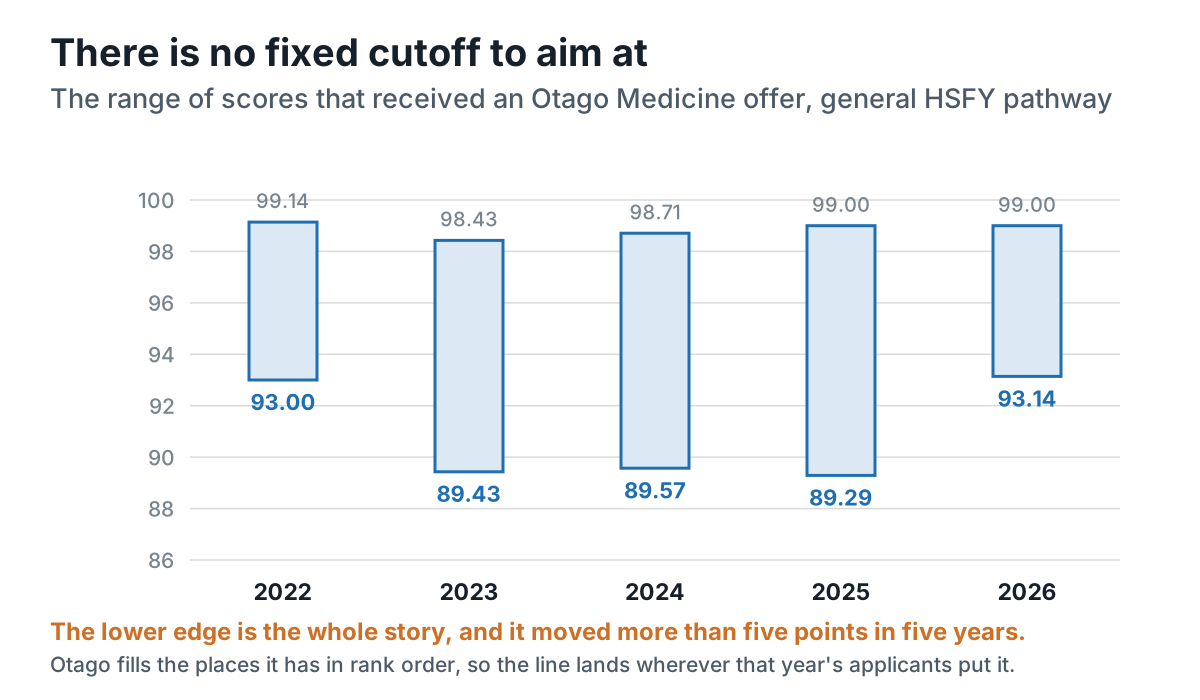
These are the ranges of average academic score that received an offer in the HSFY general pathway. The number in brackets, where shown, is the lowest score that got a first round offer rather than a waiting list offer, which is the more useful figure.
| Intake year | Otago Medicine, general HSFY | Otago Dentistry, general HSFY |
|---|---|---|
| 2024 | 89.57 to 98.71 (95.43) | 90.14 to 98.71 |
| 2025 | 89.29 to 99.00 (90.86) | 96.14 to 99.00 (97.00) |
| 2026 | 93.14 to 99.00 | 97.00 to 98.57 (97.43) |
Why the cutoff is not a number you can plan around
Look at the medicine column. The lowest successful score was 89.57, then 89.29, then 93.14. It moved more than five percentage points in three years. There is no fixed bar. Otago admits the number of people it has places for, in rank order, so where the line falls depends entirely on who else applied that year. Anyone quoting you a single target number is guessing.
Dentistry is now the harder door
This surprises almost everyone. In 2026 the lowest general pathway score that got into Otago Dentistry was 97.00, against 93.14 for Medicine. In 2022 it was the other way round, 88.71 for Dentistry against 93.00 for Medicine.
The cause is in the same report. Dentistry general pathway offers to HSFY students fell from 75 in 2023 to 30 in 2026, while general pathway applications rose from 214 to 286. Fewer places, more applicants, and the line went up nearly ten points.
The sub-categories
Otago selects equity group applicants first, in a published order: Māori, Resident Indigenous Pacific, Refugee Background, Socioeconomic Equity, then Rural, before general applicants. The policy governing this is the Admissions Policy for Health Sciences Professional Programmes, last revised in November 2025. You may still see it called "Mirror on Society", which was the 2012 name, or Te Kauae Parāoa. Both are superseded.
Otago does not publish quotas for these pathways, by design. The score ranges it does publish are outcomes, not targets, and they vary widely year to year because the numbers involved are small. Otago suppresses any figure covering fewer than five people.
Auckland's equity pathways are MAPAS for Māori and Pacific students and RRAS for rural applicants, which uses StatsNZ urban accessibility classifications. Note that ROMPE is an Otago scheme and does not apply at Auckland. At Auckland the equity places are carved out of the 317, not added to it.
If you are eligible for one of these pathways, start the verification of ancestry or eligibility early. It is a separate process with its own evidence requirements and it is not something to begin in the week before applications close.
If you already have a degree
Both schools take graduates, and Otago runs two routes.
The Graduate category ranks on a weighted GPA, where 100 level papers are weighted 0.5, 200 level 1.0 and 300 level 1.5. Otago publishes a calculator spreadsheet for this. For the 2027 intake onwards it has introduced a new weighted GPA calculation, so if you are working from an older guide or an older spreadsheet, get the current one.
The Alternative category is the other Otago route, it does have an interview, and it is capped at up to 10 percent of the overall places, allocated before the HSFY and Graduate split.
Waikato's MD, from 2028, selects on GAMSAT rather than UCAT. If you are a graduate or will be one by 2028, that is a third door that did not exist before, and it is worth watching for its entry requirements to be published.
The dates that actually matter
- UCAT ANZ booking closes in mid May, and the test window runs July into early August. Miss the booking deadline and your entire application year ends there.
- Otago HSFY and Graduate applications opened 1 July 2026 and closed 13 August 2026.
- Otago Alternative category opens 1 April and closes 1 May.
- Otago outcomes for HSFY and Graduate are released by 18 December.
- There is no allowance for late applications. None.
Always check the current year's dates on the university's own page. These move.
What it costs
Check the fees page for the year you are actually enrolling in, and make sure you are reading the domestic table. The single most common mistake here is quoting the international first year fee at a domestic student, which produces a number several times too large and puts people off before they start. Domestic students in New Zealand are also eligible for student loans and allowances through StudyLink, which is a separate application with its own deadlines.
What happens if you do not get in
Most people who apply do not get in, and almost no guide writes this section honestly, which is strange given it is the outcome for about two thirds of applicants.
Your options are real. You can complete a degree and apply again through the Graduate category, which is a well worn path rather than a consolation prize. You can take one of the other programmes HSFY selects for, several of which have shorter routes into clinical work. From 2028 there is Waikato's graduate MD. There are Australian schools. And if you did not clear the academic bar, it is worth being honest with yourself about whether the problem was ability or method, because for a lot of students it is method, and that is fixable.
What you cannot do is reapply in the Otago HSFY category. That route is once only.
Common questions
How hard is it to get into medicine in New Zealand?
Roughly one in three applicants gets in at Otago. Otago received 1,141 applications for its 2026 intake and admitted 347, about 30 percent. Auckland received 1,718 applications for 317 domestic places. The competition is concentrated in the general category, where the lowest successful Otago score in 2026 was 93.14.
What UCAT score do you need for Otago Medicine?
There is no total score cutoff. Otago sets percentile thresholds in individual domains each year. For 2027 entry they were the 20th percentile in Verbal Reasoning and the 10th percentile in Situational Judgement. Clear them and your UCAT stops counting entirely, because selection is then on academic score alone.
Does Otago Dentistry require UCAT?
No. Otago removed the UCAT requirement from all dentistry admission categories in 2024, effective from the 2025 intake. Several guides still say it is required and they are out of date. Dentistry selection rests on academic score and an interview.
Is Auckland really dropping the UCAT?
Yes, for entry from 2028. Announced in May 2026. Ranking becomes 50 percent MMI and 50 percent Casper, with GPA reduced to a threshold. Students entering in 2027 are unaffected and are still ranked 60 percent GPA, 25 percent MMI, 15 percent UCAT.
What GPA scale does Otago use?
A percentage average, not a 4.0 scale. Your academic score is the plain mean of your best seven HSFY paper marks as percentages. The American 4.0 grade point system does not apply here.
Do I need Chemistry and Physics in Year 13?
Not as a requirement, but take them. There are no subject prerequisites for HSFY entry. Chemistry, Physics and Calculus are strongly recommended and the first semester is built assuming you have them, so arriving without one is a real disadvantage rather than an administrative problem.
How to actually prepare
The honest version. For Otago, your entire application is seven sets of exam marks, so preparation means getting good at those seven papers and at sitting timed papers under pressure. For Auckland from 2028, your marks only get you to the interview, and the ranking happens in an MMI room and on Casper, which are skills you have to practise out loud rather than read about.
Cutline is built by Otago medical and dental students for exactly this. There are question banks and timed mock exams for the HSFY papers, and an MMI simulator with real Auckland style stations and per station feedback. The first mock in each paper is free, so you can see whether it is any use to you before deciding anything.
If you are starting first year, Cutline Summer runs from mid November to the end of February and covers the first year papers before you sit them. Enrolment opens on 2 November 2026, and the waitlist and the application are both free and open now.
Cutline is not affiliated with the University of Otago, the University of Auckland or the University of Waikato. Every figure on this page comes from those universities' own published admissions pages and statistics reports, read on 17 September 2026, and admissions rules change every year. Always check the official page for the year you are actually applying in.