

There is no UCAT score that gets you into medicine in New Zealand. Not a low one, not a high one, not a secret one. No New Zealand university publishes a total score cutoff, one of them stops counting your UCAT the moment you clear a threshold, one has never used it for dentistry since 2024, and the other is removing it from medical selection entirely. Almost every page that answers this question is answering it for Australia or the United Kingdom.
This is what the UCAT is worth at each New Zealand school, in each entry year, and the one date on the calendar that can end your application year before it starts. Every figure comes from the universities' own admissions pages and from the UCAT ANZ consortium, read on 17 September 2026.
The short answer
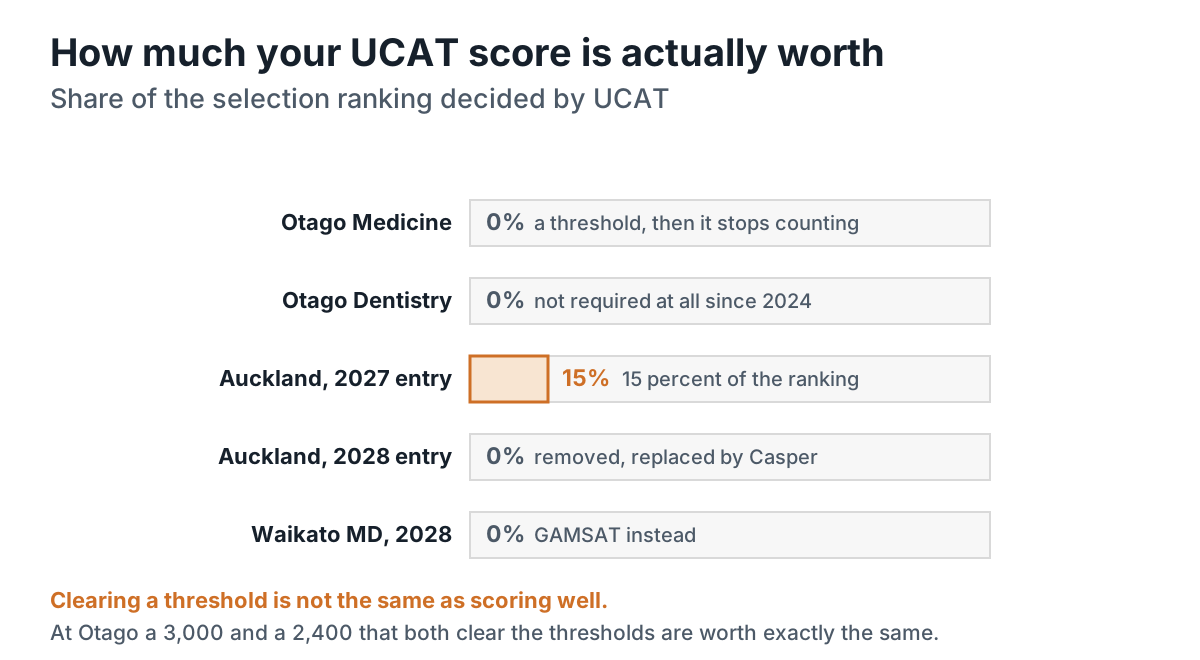
The UCAT is a gate, not a score, in New Zealand. Otago sets percentile thresholds in individual domains and then gives your UCAT no weight at all in the ranking. Auckland weighted it at 15 percent for 2027 entry and has removed it completely for 2028 entry. Nothing in New Zealand asks you to hit a number.
| Programme and entry year | UCAT required? | What it is worth in the ranking |
|---|---|---|
| Otago Medicine, HSFY and Graduate categories | Yes, in all four domains, from the year you apply | Nothing. A threshold only |
| Otago Medicine, Alternative category | No | Not taken into consideration at all |
| Otago Dentistry, 2025 intake onwards | No | Not used |
| Auckland Medicine, 2027 entry | Yes, a current result with a score in all four sections | 15 percent of the ranking |
| Auckland Medicine, 2028 entry | No | Abolished, replaced by Casper |
| Auckland Pharmacy, Optometry, Medical Imaging | No | Never used it |
| Waikato MD, first intake 2028 | No | GAMSAT instead |
Otago: clear the hurdle, then it stops counting
Otago requires a UCAT ANZ result in all four domains, obtained in the year you apply, for both the Health Sciences First Year and the Graduate categories. It then applies percentile thresholds set annually by the Medical Admissions Committee.
For entry to the 2027 programme, the thresholds were:
- Verbal Reasoning, at or above the 20th percentile
- Situational Judgement, at or above the 10th percentile
Read those numbers carefully, because most people read them backwards. Otago is not selecting the top of the distribution. It is excluding roughly the bottom fifth in Verbal Reasoning and roughly the bottom tenth in Situational Judgement. There were no published thresholds at all in Decision Making or Quantitative Reasoning for 2027 entry, although Otago states that thresholds in the other domains may be applied at a later date, so that is open from year to year.
And then it is worth zero
This is the part that should change how you spend your time. Otago states that once the eligibility threshold is met, UCAT scores are not given weight in the further selection process. The final determining factor is academic score, which is the plain mean of your best seven HSFY paper marks.
So a 2,900 and a 2,150 that both clear the thresholds are worth exactly the same to your Otago application. Not nearly the same. The same. Every hour you spend pushing a passing UCAT higher is an hour that does nothing at all for your Otago rank, and those same hours in CHEM 191 would.
There is also no interview anywhere in the Otago HSFY medicine route, so the UCAT is the only non academic thing in the process, and it does not count either. If you want the whole pathway rather than just the test, we have laid it out in our guide to how to get into medicine in New Zealand.
Otago Dentistry does not use the UCAT at all
This is the most out of date fact in the New Zealand search results. Otago removed the UCAT requirement from all dentistry admission categories in 2024, effective from the 2025 intake onwards. The dentistry guidelines page does not mention the UCAT once, and the UCAT ANZ consortium lists the University of Otago for Medicine only.
If dentistry is your only application, you do not need to sit the UCAT, and paying for a preparation course on the strength of a guide written in 2023 is a real and avoidable cost. If you are applying to both, you do need it, because medicine still requires it. The rest of the dentistry picture, including the mark floor that catches people out, is in our guide to how to get into dentistry in New Zealand.
Auckland: 15 percent, then nothing
Auckland is the only New Zealand school that has ever given the UCAT real weight, and it is in the middle of taking that away.
The year numbering trap
Auckland's announcement says the change applies from 2027, and its programme page says 2028 entry. Both are correct, because the announcement means the year you apply and the programme page means the year you start. Auckland's own release resolves it: current first year students applying for clinical programmes starting in 2027 are not affected.
The practical translation is simple. Applying during 2026 for a 2027 start means old rules and a UCAT. Sitting first year during 2027 for a 2028 start means new rules and no UCAT. Get this the wrong way round and you either sit a test you did not need or skip one you did.
2027 entry, the last year the UCAT counts
Ranking is a composite of 60 percent GPA, 25 percent MMI and 15 percent UCAT, combined as z scores rather than as raw percentages. Applicants need a current result with a score in all four sections.
The z score part matters more than the 15 percent does. Because each component is standardised against the cohort, your UCAT contribution depends on how far above or below the average of that year's applicants you sat, not on an absolute number. That is another reason no fixed target exists.
2028 entry, the UCAT is gone
From 2028 entry, Auckland removes the UCAT from MBChB selection entirely and replaces it with Casper, a situational judgement test from Acuity Insights sat in the year of application. The ranking becomes 50 percent MMI fair score and 50 percent Casper, and GPA drops from 60 percent of the rank to a threshold you either clear or do not.
So for anyone starting first year at Auckland in 2027, the UCAT is simply not part of your life. Casper is.
The test itself changed in 2025
Abstract Reasoning was withdrawn from the UCAT from 2025, on the stated grounds that it had lower predictive validity and was highly coachable. That leaves three cognitive subtests plus Situational Judgement.
| Subtest | Questions | Time |
|---|---|---|
| Verbal Reasoning | 44 | 22 minutes |
| Decision Making | 35 | 37 minutes |
| Quantitative Reasoning | 36 | 26 minutes |
| Situational Judgement | 69 | 26 minutes |
The whole thing runs just under two hours. Each of the three cognitive subtests is scaled from 300 to 900, so the cognitive total now runs from 900 to 2,700 rather than the 1,200 to 3,600 that four subtests produced. Situational Judgement is reported in four bands, Band 1 being the strongest and Band 4 the weakest. Marking is on correct answers only, with no penalty for a wrong one, so there is never a reason to leave a question blank.
Two consequences of the Abstract Reasoning change that catch people out. Older total score figures quoted in guides and forum threads are on the four subtest scale and are not comparable with yours. And Otago's requirement for a result "in all four domains" now means Verbal Reasoning, Decision Making, Quantitative Reasoning and Situational Judgement, which is a different set of four from the one that phrase used to describe.
The deadline that ends your application year
The UCAT booking deadline is the single most dangerous date in this process, because there is no appeal, no late alternative once the final late deadline passes, and no way to apply to Otago medicine without a result from that year.
The 2026 cycle, which served 2027 entry, ran like this.
| Milestone | 2026 cycle date |
|---|---|
| Concession Scheme and Access Arrangements open | 16 February 2026 |
| Booking opens | 3 March 2026 |
| Access Arrangements application deadline | 11 May 2026 |
| Booking deadline | 15 May 2026 |
| Late booking deadline | 29 May 2026 |
| Final late booking deadline | 5 June 2026 |
| Cancellation deadline for a refund | 12 June 2026 |
| Testing window | 1 July to 5 August 2026 |
| Results delivered to universities | Early September 2026 |
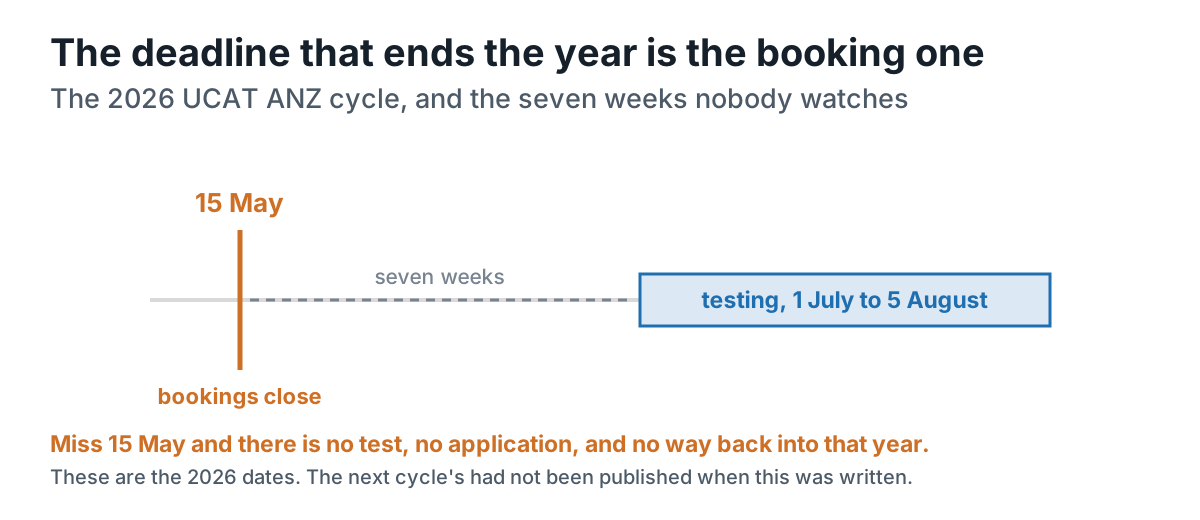
Notice the gap. Booking closed on 15 May for a test that was not sat until July at the earliest. Students miss it every year because the test feels far away when the deadline is not.
As at 17 September 2026 the UCAT ANZ site still showed the 2026 cycle, so the dates for the next cycle were not yet published. Check ucat.edu.au yourself the moment your cycle opens, and put the booking deadline in a calendar the same day, not the test date.
Test centres operate in Auckland, Christchurch, Dunedin, Invercargill, New Plymouth and Wellington. Dunedin having a centre matters if you are sitting HSFY, because the testing window falls in the middle of the second semester.
So what should you aim for?
The honest answer, which no coaching site will give you:
- For Otago, aim to clear the thresholds comfortably and then stop. Comfortably, because percentile thresholds shift with the cohort and because Otago reserves the right to add thresholds in the other two domains. Then stop, because past that line the score is worth nothing.
- For Auckland 2027 entry, above average helps, in proportion. It is 15 percent of a standardised composite, so a strong UCAT is a modest advantage and a weak one is a modest handicap. It is not the thing that decides your application. GPA at 60 percent is.
- For Auckland 2028 entry onwards, do not sit it for Auckland at all. It is not part of the selection. Sit it only if Otago is also on your list.
And a warning about the numbers you will find. Australian medical schools do publish and use UCAT cutoffs, and Australian coaching sites write for that market. A page telling you that you need a particular total, or an ATAR alongside it, is describing a system New Zealand does not run.
Common questions
What is the lowest UCAT score to get into medicine?
In New Zealand there is no published answer, because no New Zealand university sets a total score cutoff. Otago publishes percentile thresholds in individual domains, currently the 20th percentile in Verbal Reasoning and the 10th in Situational Judgement, and gives the score no weight beyond that. Auckland weighted it at 15 percent for 2027 entry and never releases UCAT data publicly. Any specific minimum you find quoted is either Australian or invented.
What UCAT score do you need for Otago Med?
No total score at all. Only percentile thresholds. For 2027 entry those were the 20th percentile or above in Verbal Reasoning and the 10th percentile or above in Situational Judgement, with a result required in all four domains from the year of application. Clear them and your UCAT stops counting, because selection is then on academic score alone.
What is considered a good UCAT score for 2026 entry?
In New Zealand terms, one that clears Otago's thresholds. There is no published good score here. Auckland's agreement with the test provider prevents it from releasing UCAT scores publicly at all, so even its own admissions dashboard excludes them, and Otago has never published a total score figure. Anything you see framed as a good score for a New Zealand application has been reverse engineered from an Australian benchmark.
Does Otago dentistry require the UCAT?
No. Otago removed the UCAT requirement from all dentistry admission categories in 2024, effective from the 2025 intake. Several guides still say it is required and they are simply out of date. You only need it for dentistry if you are also applying to medicine.
Is Auckland really dropping the UCAT?
Yes, from 2028 entry. It was announced in May 2026. Selection becomes 50 percent MMI and 50 percent Casper, with GPA reduced to a threshold. Students entering in 2027 are unaffected and are still ranked on 60 percent GPA, 25 percent MMI and 15 percent UCAT.
How hard is it to get into medicine in NZ?
Roughly one in three at Otago, and the UCAT is not the reason. Otago admitted 347 students from 1,141 applications for its 2026 intake, and the lowest average academic score that received a general pathway offer was 93.14. Auckland received 1,718 applications for 317 domestic places. The competition happens in marks and interviews, not in the admissions test.
How to prepare
Cutline does not sell UCAT preparation, so this is not a pitch. The honest advice is that the UCAT deserves enough of your attention to clear the thresholds and not a minute more if Otago is your target, and proportionate attention if you are an Auckland 2027 applicant. The single most valuable thing you can do about the UCAT is book it on time.
Where the competition happens is the two places we do build for. Cutline is made by Otago medical and dental students, with question banks and timed mock exams for all seven Health Sciences First Year papers, and the first mock in every paper is free so you can judge it before deciding anything. For Auckland there is an MMI simulator with real Auckland style stations and per station feedback, which is the half of the Auckland ranking that people practise least. Otago does not run an MMI, so that part is for Auckland applicants only.
If you are about to start first year, Cutline Summer runs from mid November to the end of February and covers the first year papers before you sit them. Enrolment opens on 2 November 2026, and the waitlist and the application are both free and open now.
Cutline is not affiliated with the University of Otago, the University of Auckland, the University of Waikato or the UCAT ANZ Consortium. Every figure on this page comes from those organisations' own published pages, read on 17 September 2026. Test dates, thresholds and selection weightings are set annually and change, so always check the official page for the year you are applying in.