
Almost nobody publishes the acceptance rate for Otago medical school, which is strange, because Otago publishes the numbers itself. For the 2026 intake the University received 1,141 applications and admitted 347 students. That is an admission rate of about 30 percent. The figure is real, it is official, and it is also the most misleading number in New Zealand medical admissions.
This is the full five year series, the offer scores that sat behind it, and the reason a general pathway applicant faces something considerably harder than one in three. Every figure comes from Otago's own Medicine Admissions Statistics report, published in April 2026 and read on 17 September 2026.
The short answer
About 30 percent for the 2026 intake. Otago admitted 347 of 1,141 applicants. Across the five intakes from 2022 to 2026 the rate has run between 29 and 36 percent, averaging about 32 percent.
One honest caveat before the table. Otago does not publish a rate. It publishes applications and admissions, and the percentages below are simply those two numbers divided. No official Otago page describes the University as having an acceptance rate, so if you see one quoted anywhere, somebody calculated it rather than announced it.
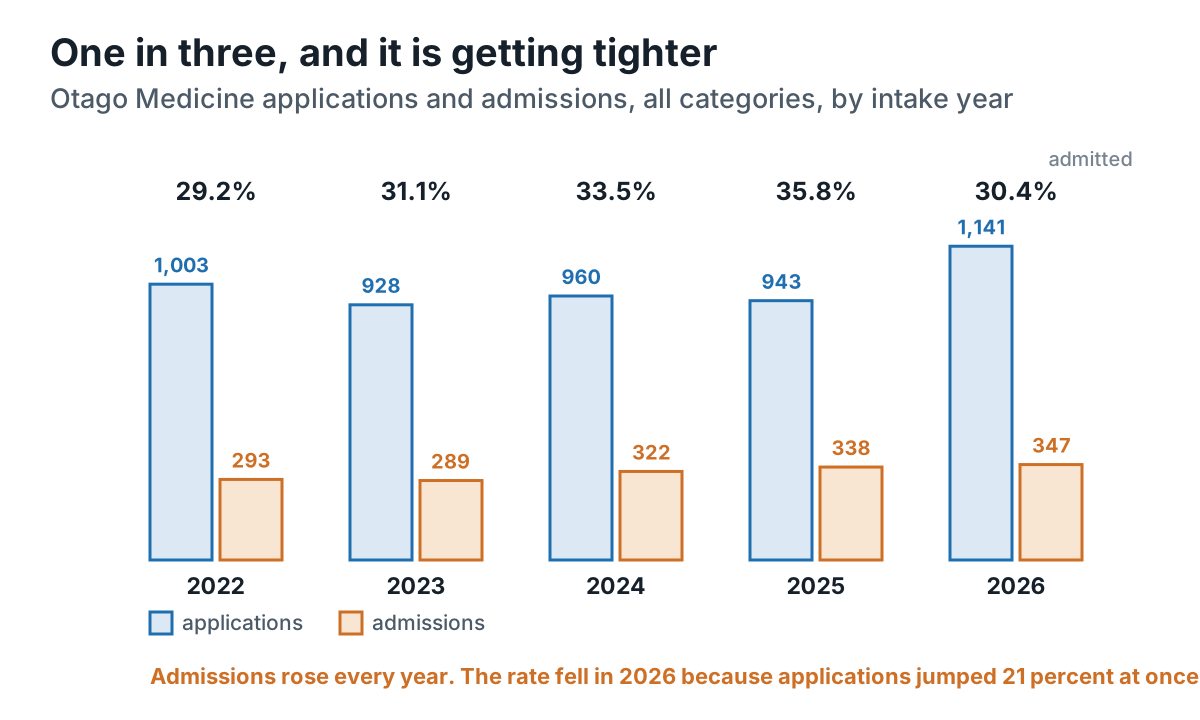
Applications and admissions, 2022 to 2026
| Intake year | Applications | Admissions | Rate |
|---|---|---|---|
| 2022 | 1,003 | 293 | 29.2% |
| 2023 | 928 | 289 | 31.1% |
| 2024 | 960 | 322 | 33.5% |
| 2025 | 943 | 338 | 35.8% |
| 2026 | 1,141 | 347 | 30.4% |
Two patterns are worth pulling out. Admissions have climbed steadily, from 293 to 347 in five years, so the school is bigger than it was. But applications jumped 21 percent in a single year between the 2025 and 2026 intakes, which is why the rate fell back to 30 percent despite the extra places.
Four things that 30 percent is not
This is the part that matters more than the number itself.
It is not one competition. The figure mixes all three admission categories together. Health Sciences First Year, Graduate and Alternative applicants are assessed against completely different criteria, ranked separately, and allocated separate blocks of places. Nobody competes against the whole 1,141.
It includes international students. The 347 admissions figure counts domestic and international admissions together. The published cap of approximately 322 domestic places for 2027 is a domestic only number, so the two are not comparable and the apparent drop from 347 to 322 is not a cut to places.
It is not the rate any individual faces. Otago selects priority pathway applicants first, in a published order, and general applicants afterwards from the places that remain. More on that below, because it is the whole story.
Otago says so itself. The statistics report states plainly that the data is historical and not indicative of outcomes in future years. It also suppresses any figure covering fewer than five people, which is why some cells in the pathway tables read as fewer than five rather than as a number.
What decides it
Once you are eligible, Otago ranks Health Sciences First Year applicants on one thing: academic score. That score is the plain mean of your best seven HSFY paper marks as percentages, with no paper weighted more heavily than another and no 4.0 grade point scale anywhere in it.
The UCAT is a threshold you clear rather than a score that counts, and there is no interview at all in the HSFY medicine route. So the question "what is the acceptance rate" resolves into a different question: where did the mark line fall. If you want the pathway rather than the numbers, we have set it out in our guide to how to get into medicine in New Zealand.
Why the general pathway is harder than 30 percent
Otago selects in a published sequence. Applicants confirmed in a priority pathway are considered first, in this order: Māori, Resident Indigenous Pacific, Refugee Background, Socioeconomic Equity, then Rural. General applicants are selected after that.
The headline rate describes a pool. What a general applicant faces is the last block of places, filled in strict order of academic score. Here is where that line landed for the HSFY category, given as the range of average academic scores that received an offer.
| Pathway, 2026 intake | Range of scores that received an offer |
|---|---|
| General | 93.14 to 99.00 |
| Māori | 65.29 to 97.14 |
| Resident Indigenous Pacific | 65.14 to 96.29 |
| Socioeconomic Equity | 66.43 to 95.86 |
| Refugee Background | 69.29 to 96.71 |
| Rural | 86.43 to 98.14 |
| International | 80.29 to 94.57 |
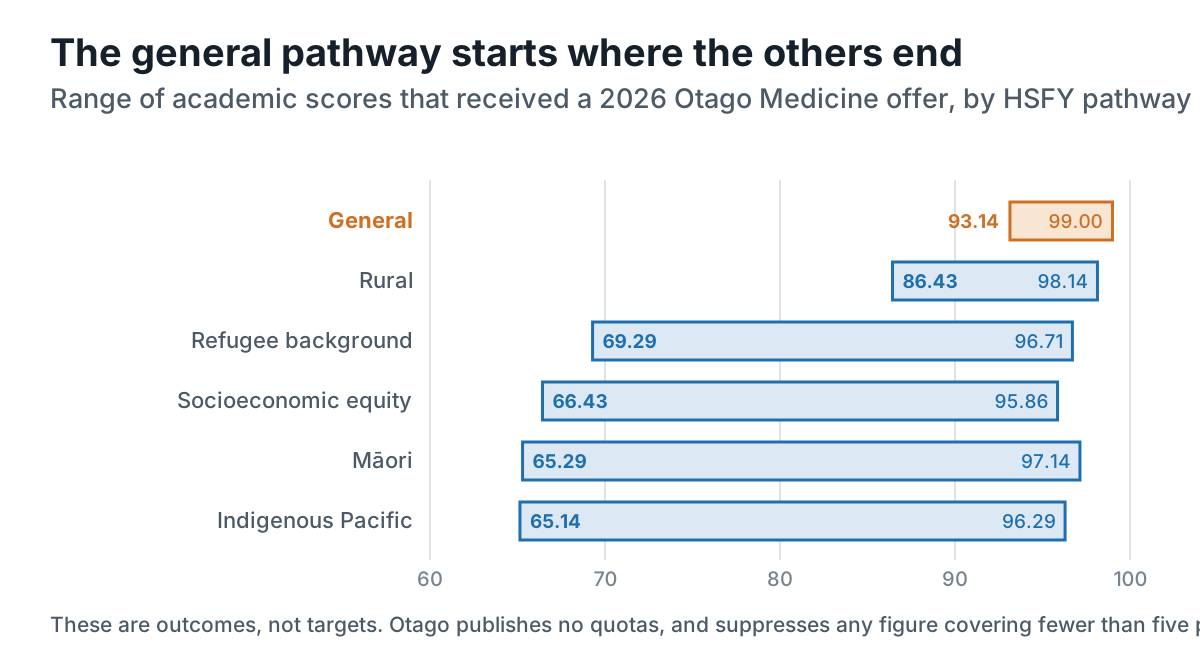
Read the general row against the eligibility bar. Otago's published minimum to be eligible in the HSFY category is a 65 percent average. For the 2026 intake, a general applicant averaging 90 percent was comfortably over the academic eligibility bar and still did not get a place.
Two things to hold on to before you use the other rows. They are outcomes, not targets. Otago publishes no quota or percentage of places for any pathway, by design, and its admissions policy leaves those numbers to each year's Admissions Committee. And the ranges cover small groups, so they move a long way from year to year for reasons that have nothing to do with how hard anything is.
The general line moves, a lot
This is the single most useful thing on this page, and it is the reason the target scores you find quoted online are worthless.
| Intake year | General HSFY range | Lowest first round offer |
|---|---|---|
| 2022 | 93.00 to 99.14 | not published separately |
| 2023 | 89.43 to 98.43 | not published separately |
| 2024 | 89.57 to 98.71 | 95.43 |
| 2025 | 89.29 to 99.00 | 90.86 |
| 2026 | 93.14 to 99.00 | not published separately |
The bottom of the general range went 93.00, then 89.43, then 89.57, then 89.29, then 93.14. It swung by nearly six percentage points in five years. Otago does not set a pass mark for entry. It fills the places it has in rank order, so the line lands wherever that year's applicants put it.
There is one comparability note Otago makes itself which nobody else repeats. From the 2024 intake onwards the published ranges include both first round and waiting list offers. Earlier years do not, so the 2022 and 2023 figures are not perfectly comparable with the rest of the column. Where a separate first round minimum is published, that is the more useful number, because it is the score that got an offer without waiting for somebody else to decline one.
How the places are divided
Otago publishes the rule and the cap, not the resulting headcounts. For 2027 the cap is approximately 322 domestic places across all categories, and the rule works like this.
- The Alternative category is allocated first, up to 10 percent of the overall places.
- What remains is split between the Health Sciences First Year and Graduate categories, with as near as possible to 70 percent of the remainder going to HSFY and the balance to Graduate.
Run that arithmetic across approximately 322 places and you land in the order of 30 Alternative places, about 200 HSFY places and about 90 Graduate places. Treat that as an illustration of the rule rather than as a published figure, because Otago does not publish the breakdown and the caps move.
If you already have a degree
The Graduate category is ranked on a weighted GPA rather than on a percentage average, so it has its own published ranges. For the general pathway, the weighted GPA that received a medicine offer ran 8.13 to 9.65 for the 2024 intake, 8.15 to 9.78 for 2025 and 8.12 to 10.33 for 2026. The lowest first round offers, where published, were 8.90 in 2024 and 8.66 in 2025.
The minimum to be eligible is a weighted GPA of 5, with a degree from a New Zealand university completed within three years of the date of application. As with the HSFY numbers, the gap between the eligibility bar and the real line is enormous.
Note also that a new weighted GPA calculation applies from the 2027 intake onwards, so an older guide or an older copy of the spreadsheet will give you the wrong answer.
Auckland, for comparison
Auckland does not publish an applications to admissions rate in the same shape, but it publishes enough to make the comparison.
For 2026 entry Auckland received 1,718 MBChB applications, up about 25 percent on the 1,370 it received the year before. Its approved limit for 2027 is 317 domestic places plus 30 international, a total of 347. That is roughly five applicants per place. Auckland also admits nine students beyond the stated limit to allow for expected attrition, so the real starting cohort is about 326 domestic.
Of those 1,718 applicants for 2026 entry, 751 were invited to the multiple mini interview. Auckland publishes the GPA cut-offs for that invitation, and the 2026 entry figure for general first year applicants was 8.25.
Do not use 8.25 as a target. It is a cut-off for an interview invitation, not for an offer, and Auckland explains on its own page that for 2026 entry the invitation GPA was calculated from final semester one grades plus a placeholder A plus for all four semester two courses. More than half of that GPA was placeholder, which pushed the published cut-off up sharply without changing anybody's rank order. Auckland also notes that for the 2023, 2024 and 2025 intakes it was able to invite every applicant who met the minimum eligibility GPA.
One structural difference is worth knowing if you are weighing up the two. At Auckland the rural and the Māori and Pacific scheme places are carved out of the 317, not added to it.
There is no 2027 number yet
Otago states in its statistics reports that admissions statistics are finalised once all admissions processes complete, usually at the end of March in the year of admission, and published after that. So the 2027 figures are expected around March 2027 and do not exist publicly before then.
Anyone giving you a 2027 cut-off today is guessing. Anyone giving you a 2028 one is guessing twice.
Common questions
What is the acceptance rate for Medicine at the University of Otago?
About 30 percent for the 2026 intake. Otago admitted 347 students from 1,141 applications. Over the five intakes from 2022 to 2026 the rate ranged from 29 to 36 percent. Otago does not publish the rate itself, only the application and admission counts.
How many med students get accepted each year?
347 for the 2026 intake, across all categories and including international students. The trend has been upward: 293, then 289, 322, 338 and 347. Otago's approved cap for 2027 is approximately 322 domestic places.
How hard is it to get into Medicine at Otago?
Much harder than the 30 percent headline if you are a general applicant. The lowest average academic score that received a general pathway HSFY offer for 2026 entry was 93.14 out of 100. The eligibility minimum is a 65 percent average, so clearing the published bar and getting a place are two very different things.
What is the minimum GPA required to be eligible for medical school in New Zealand?
At Otago, a 65 percent average across your best seven HSFY papers. At Auckland, a GPA of 6.0. Both are eligibility thresholds rather than competitive scores, and neither is close to what it has taken in the general pathway.
Is 3.7 too low for med school?
The 4.0 scale is an American thing and it does not apply here. Otago ranks Health Sciences First Year applicants on a percentage average of seven paper marks. Auckland uses a GPA scale on which 6.0 is a B plus. If a page is talking to you about a 3.7, it is not talking about New Zealand.
What is the easiest medical school to get accepted to?
There is no published answer to that in New Zealand, and the two sets of numbers are not comparable. Otago admitted about 30 percent of applicants for 2026. Auckland received 1,718 applications for 317 domestic places. Otago's figure covers three admission categories at once, including graduate and alternative entrants, so it is not a like for like ratio. Waikato has not opened yet.
How to prepare
The honest read of everything above is that for Otago there is nothing to optimise except your marks. No interview, no weighted UCAT, no personal statement in the HSFY route. Seven papers, one average, one rank order. That is a brutal system in some ways and a clean one in others, because it tells you exactly what to work on.
Cutline is built by Otago medical and dental students for those seven papers. There are question banks and timed mock exams for each of them, and the first mock in every paper is free, so you can find out whether it helps you before you decide anything. If Auckland is also on your list, there is an MMI simulator with real Auckland style stations and per station feedback. Otago does not run an MMI, so that part is for Auckland applicants only.
If you are about to start first year, Cutline Summer runs from mid November to the end of February and covers the first year papers before you sit them. Enrolment opens on 2 November 2026, and the waitlist and the application are both free and open now.
Cutline is not affiliated with the University of Otago or the University of Auckland. Every figure on this page comes from those universities' own published admissions pages, statistics reports and programme limitations, read on 17 September 2026. Otago states that its admissions data is historical and not indicative of future outcomes, and admissions rules change every year, so always check the official page for the year you are applying in.