 Cutline SummerFor your next chapter at Otago
CELS191
Summer prep course.
Prepare for Otago HSFY with cell biology, genetics and microbiology. Cutline Summer connects how a cell works with DNA, inheritance and infection, with guided explanations and practice.
Included in the whole Cutline Summer programme.
How a cell membrane works
Water meets the membrane on both sides. Look at which parts of each phospholipid face the water, and which parts face one another.
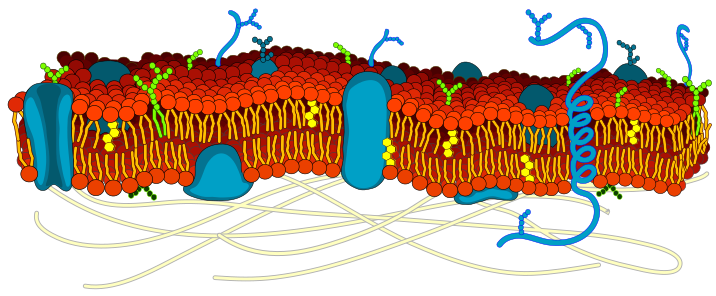 View full-size diagram
A closer look at the phospholipid bilayer. Simplified diagram, not to scale.
Image credit
Illustration by Mariana Ruiz (LadyofHats), labels removed by Masur.
Public domain. Image unchanged.
How to prepare for CELS191
If biology has mostly meant memorising names at school, use summer to practise explaining a process. A labelled cell is a start. Explaining how a change to its membrane affects movement of a substance is the next step.
Connect structures to jobs
Sketch a cell from memory. Beside each structure, write what it does and what would change if it stopped working. Check your school notes, then redraw the parts you missed.
Separate DNA, genes and chromosomes
Explain how these terms relate before revising inheritance. Then trace the path from DNA to RNA to protein. Keep the process and the location clear in your explanation.
Explain movement across a membrane
Practise distinguishing diffusion, osmosis and active transport. Draw the concentration gradient and state whether energy or a transport protein is involved.
Try the reasoning
An introductory Cutline example, not an official exam question.
A membrane protein that uses ATP to move a solute against its concentration gradient stops working. What happens to that transport process?
Show the explanation
Transport through that protein stops. Movement against the gradient needs the energy supplied by ATP. This does not mean all movement across the membrane stops: other channels, carriers and diffusion routes may still operate.
Name the affected mechanism, explain why it changes, and keep the claim specific to the information given.
What the CELS191 Summer course will cover
Tutors will walk you through realistic cell biology exam-style questions, showing how to use the concepts to work out the answer.
Planned Cutline Summer modules. These describe our preparation scope, not an official university course outline or a claim that every assessment is covered.
Life and its building blocks
Living systems, natural selection, evolutionary trees, cell types, carbohydrates, proteins, lipids and nucleic acids.
Practise applying it: Compare cell features and use them to justify a classification or evolutionary relationship.
Membranes and cellular transport
Membranes, diffusion, osmosis, active transport, compartments, protein trafficking, endocytosis, exocytosis and cellular recycling.
Practise applying it: Predict how water or a solute moves when membrane conditions change.
Cell shape and organisation
Cytoskeleton, cell junctions, extracellular matrix, plant walls, turgor, nuclear pores, ribosomes and DNA packing.
Practise applying it: Connect a damaged cell structure with the function most likely to be affected.
How cells obtain energy
ATP, cellular respiration, proton gradients, ATP synthase, photosynthetic light reactions and carbon fixation.
Practise applying it: Trace energy transfer and predict how disrupting a proton gradient affects ATP production.
DNA and gene expression
DNA structure, transcription, RNA processing, the genetic code, translation, DNA replication and repair.
Practise applying it: Read a sequence and connect a DNA change to its possible effect on a protein.
Cell division and chromosomes
Chromosome sets, the cell cycle, mitosis, meiosis, genetic variation, chromosome abnormalities and X-inactivation.
Practise applying it: Track chromosomes through division and explain how an abnormal distribution could arise.
Inheritance and population change
Genetic crosses, probability, dominance, environmental effects, linked genes, allele frequencies, drift and selection.
Practise applying it: Use a genetic cross or allele frequencies to calculate a stated inheritance probability.
Genomes and human health
Reference genomes, genetic variation, comparative genomics, ancient DNA, mutation effects, pedigrees and disease risk.
Practise applying it: Use a pedigree and variant evidence to evaluate an explanation for inherited disease.
Studying and changing gene function
Gene experiments, transgenesis, gene editing, gene therapy, cell differentiation, stem cells, PCR and genetic tests.
Practise applying it: Choose a genetic method and explain what its result can establish.
Bacteria and microbial communities
Bacterial structure, Gram staining, survival, growth, metabolism, microbial communities, research methods and the microbiome.
Practise applying it: Interpret a growth curve and use cell features to distinguish bacterial groups.
Viruses, infection and evolution
Viruses, replication, bacterial gene transfer, phages, infection, toxins, antibiotic targets, resistance and pathogen evolution.
Practise applying it: Explain why an antibiotic targets a bacterium and how resistance can spread.
Part of Cutline Summer
One programme covering CELS191, CHEM191, PHSI191 and HUBS191. Choose Summer for the course, or Summer + Mentoring for additional support.
Short lessons, tutor walkthroughs and exam-style practice are planned for Summer. Try a beta lesson to see the approach while the full programme is being built.
- Summer
- NZ$699
- Summer + Mentoring
- NZ$1,199
- Programme access
- 16 November 2026 to 28 February 2027
Prices are in NZD and include GST. These are whole-programme plans, not separate paper purchases.
Join the free waitlistConfirm your email for Summer updates and the free student guide. No payment today.
Compare plans and enrolment datesQuestions about CELS191 preparation
Should I learn all of CELS191 before university?
You do not need to turn summer into a full semester. Our suggested starting point is cells, membranes and the relationship between DNA and proteins. Use those foundations to follow unfamiliar examples, then explore the wider Summer modules if you want more structure.
Is this different from the CELS191 question bank?
Yes. Summer is preparation before the year begins. If you are already taking the paper, visit CELS191 practice questions for the in-year practice options.
For official paper information, see Otago’s CELS191 page and its HSFY preparation guidance.
Explore the other Summer papers
Read the HSFY summer preparation guide


Cutline is independent of the University of Otago. Summer is optional preparation, not a university paper or a requirement for admission. Summer is new, so programme outcomes are not yet measured.