 Cutline SummerFor your next chapter at Otago
HUBS191
Summer prep course.
Learn to connect a body structure with what it does. HUBS191 preparation in Cutline Summer begins with anatomical language and homeostasis, then explores movement, neural signals, hormones and immune defence.
Included in the whole Cutline Summer programme.
Four tissues, one working body
An organ brings different tissues together. In the gut, a lining, supporting tissue, muscle and nerves each do a different job.
 Illustration
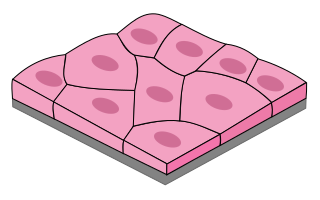
A thin, continuous sheet
These flat cells fit closely together. The darker ovals are nuclei. This simple squamous epithelium forms a thin lining with very little space between cells.
Image credit
Creator: Kamil Danak
Source on Wikimedia Commons: Simple squamous epithelium.svg
Licence: CC BY-SA 3.0
Original image, unchanged by Cutline.
How to prepare for HUBS191
A long list of anatomical terms can feel productive without helping you explain a system. Pair a term with a diagram, a function and a change you can predict. That gives the vocabulary a purpose.
Use anatomical language precisely
Revisit anatomical position, body planes and movement terms. Describe a movement in words, then check it on a diagram rather than relying on everyday labels such as “up” or “back”.
Draw a feedback loop
Pick a regulated variable and label the sensor, control centre and response. Explain how the response changes the original disturbance. Keep the variable separate from the mechanism regulating it.
Trace a cause through the system
Follow a signal from its trigger to its effect. For a muscle example, connect activation to contraction and movement. Ask what would happen if a link in that sequence changed.
Try the reasoning
An introductory Cutline example, not an official exam question.
A regulated variable rises above its usual level. What makes a response negative feedback?
Show the explanation
The response acts to reduce the original rise, moving the variable back towards its regulated level. “Negative” describes opposition to the disturbance, not whether the response is harmful or whether every quantity decreases.
Explain the direction of the response relative to the disturbance, rather than treating “negative” as a value judgement.
What the HUBS191 Summer course will cover
Tutors will give you realistic HUBS exam-style questions and teach you how to solve them, explaining the concepts and reasoning behind each answer.
Planned Cutline Summer modules. These describe our preparation scope, not an official university course outline or a claim that every assessment is covered.
Body organisation and anatomical language
The four basic tissues, homeostasis, feedback, anatomical position, body planes and joint movements.
Practise applying it: Identify tissue from its features and describe a movement using precise anatomical terms.
Bones and joints
Skeletal organisation, bone cells, remodelling, growth, connective tissues, joint types and movement.
Practise applying it: Use joint structure to explain which movements are possible and which are restricted.
Muscle and movement
Osmosis, membrane potentials, muscle contraction, force, fibre types, levers, muscle actions, stance and gait.
Practise applying it: Trace muscle activation to contraction and explain a change in force or movement.
Reading biomedical data
Samples, bias, variation, variable types, summary statistics, standard error, graphs, confidence intervals and null models.
Practise applying it: Interpret a confidence interval and identify a source of bias in a biomedical study.
Neurons and neural signals
Nervous system organisation, neurons, glia, autonomic control, membrane channels, action potentials and synapses.
Practise applying it: Explain how changes at the membrane trigger or prevent an action potential.
Brain, spinal cord and pathways
Spinal structures, peripheral nerves, protective layers, cerebrospinal fluid, brain regions and sensory and motor pathways.
Practise applying it: Use a pathway diagram to locate where damage could cause a stated deficit.
Sensation and motor control
Sensory receptors, adaptation, stimulus coding, movement planning, muscle activation and stretch and withdrawal reflexes.
Practise applying it: Trace a reflex pathway and predict how changing one part affects the response.
Hormones and homeostasis
Hormone action, pituitary control, growth, thyroid function, calcium, stress responses, glucose regulation and diabetes mechanisms.
Practise applying it: Use a feedback loop to predict how hormone levels respond to a disturbance.
Immune defence
Barriers, immune cells, inflammation, complement, antigen presentation, antibodies, memory, tolerance, allergy and vaccination.
Practise applying it: Explain which immune cells and mechanisms respond to a stated infection or vaccination.
Part of Cutline Summer
One programme covering CELS191, CHEM191, PHSI191 and HUBS191. Choose Summer for the course, or Summer + Mentoring for additional support.
Short lessons, tutor walkthroughs and exam-style practice are planned for Summer. Try a beta lesson to see the approach while the full programme is being built.
- Summer
- NZ$699
- Summer + Mentoring
- NZ$1,199
- Programme access
- 16 November 2026 to 28 February 2027
Prices are in NZD and include GST. These are whole-programme plans, not separate paper purchases.
Join the free waitlistConfirm your email for Summer updates and the free student guide. No payment today.
Compare plans and enrolment datesQuestions about HUBS191 preparation
Is HUBS191 preparation the same as HUBS192 mini essay practice?
No. This Summer page covers preparation for Human Body Systems 1 before HSFY. HUBS192 is a different paper, and practice for assessments during the year belongs in the student question bank.
Is this different from the HUBS191 question bank?
Yes. Summer is preparation before the year begins. If you are already taking the paper, visit HUBS191 practice questions for the in-year practice options.
For official paper information, see Otago’s HUBS191 page and its HSFY preparation guidance.
Explore the other Summer papers
Read the HSFY summer preparation guide


Cutline is independent of the University of Otago. Summer is optional preparation, not a university paper or a requirement for admission. Summer is new, so programme outcomes are not yet measured.