Question 1
Place 'Yes' if the conclusion follows. Place 'No' if it does not follow.
Five correct earns 2 marks. Four correct earns 1 mark.
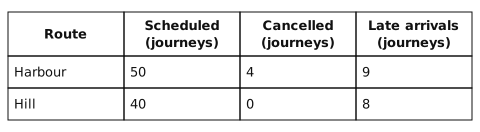
Yes: Harbour operated six more journeys than Hill. Subtract cancellations from scheduled journeys on each route. Comparing the scheduled totals alone would miss the four Harbour cancellations.
Yes: Among operated journeys, Hill had a higher late proportion than Harbour. Use operated journeys as each denominator. Hill's smaller late count can still give the higher proportion, since 368 is greater than 360 after cross-multiplication.
No: At least 40 Harbour journeys arrived on time. First remove four cancellations, then nine late arrivals. Treating every non-cancelled journey as on time overlooks the late journeys.
Yes: Across the two routes, 69 journeys arrived on time. Work out each route's on-time count before adding. The two routes cover the whole trial, so no other route needs to be included.
No: More than five Harbour journeys were late because of bad weather. The late count says nothing about why those journeys were late. Zero weather-related delays would fit the report, as would six.
Common trap: valid inference doubted.