For Otago HSFY 2027

A head start on HSFY.A summer that’s still yours.

Get comfortable with physics, chemistry and the foundations of health science. Short lessons, practice and support, at your own pace.

School exams first. Summer can wait until you finish.

Confirm your email for Summer updates and the free HSFY guide. No payment today.

Summer programme: NZ$699See plans

Lesson previewFrom the Summer beta

How a cell membrane works

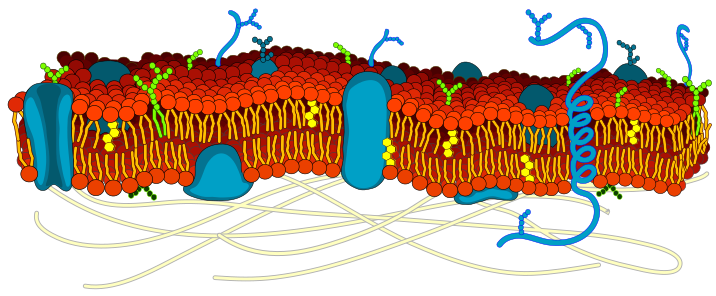
Water meets the membrane on both sides. Look at which parts of each phospholipid face the water, and which parts face one another.

A cell membrane has two layers of phospholipids. Their water-facing heads point outward, while their nonpolar tails face inward, away from water.View full-size diagram

A closer look at the phospholipid bilayer. Simplified diagram, not to scale.

Image credit

Illustration by Mariana Ruiz (LadyofHats), labels removed by Masur.

Wikimedia Commons

Public domain. Image unchanged.

Try it yourselfWhere do phospholipid tails face in a bilayer?
Platform access16 November 2026 to 28 February 2027

Access opens 16 November 2026. Start after your last school exam and learn at your own pace until 28 February 2027.

Understand the concepts. Use them in the exam.

Get a head start on the semester one papers with realistic exam-style questions. Tutors will teach you how to solve them and explain the concepts as you go.

From understanding to answering.

  1. Start with a realistic question

    Tutors give you exam-style questions that put the concepts into context.

  2. See how to solve it

    Follow a tutor’s explanation, step by step, to understand how to reach the answer.

  3. Understand the method

    Use the walkthroughs and interactive explanations to understand why the method works.

Choose a paper and explore the modules you’ll work through over Summer.

Counts show the lectures these topics draw from. Some lectures contribute to more than one module.

PHSI 191Biological physics

Build your maths foundations, then connect motion, matter, energy and light to biological problems.

9 modules

How to prepare for PHSI 191 over summer ↗

How you’ll learn

Tutors will walk you through realistic physics exam-style questions, explaining how to choose an approach and work through the calculations.

Modules in this paper

  1. Module 1Topics from 7 lectures

    Physics jumpstart

    Concepts you’ll cover

    Units, graphs, algebra, ratios, trigonometry, vector components, scientific notation and logarithms.

    Practise for the exam

    Rearrange an equation, substitute values and check the units and sign of your answer.

  2. Module 2Topics from 4 lectures

    Motion and forces

    Concepts you’ll cover

    Displacement, acceleration and projectiles; force diagrams, friction, drag, circular motion, torque and equilibrium.

    Practise for the exam

    Draw a force diagram and use Newton’s laws to justify the resulting motion.

  3. Module 3Topics from 2 lectures

    Energy and momentum

    Concepts you’ll cover

    Work, kinetic and potential energy, conservation, power, efficiency, momentum, impulse and collisions.

    Practise for the exam

    Choose an energy or momentum model and explain what is conserved in a collision.

  4. Module 4Topics from 1 lecture

    Oscillations and waves

    Concepts you’ll cover

    Spring forces and energy, simple harmonic motion, wave propagation, interference and standing waves.

    Practise for the exam

    Use a wave pattern to identify nodes and connect wavelength with frequency.

  5. Module 5Topics from 6 lectures

    Solids and fluids

    Concepts you’ll cover

    Density, deformation, pressure, buoyancy, surface tension, fluid flow, viscosity, diffusion and osmosis.

    Practise for the exam

    Calculate pressure or flow and state which assumptions make your model appropriate.

  6. Module 6Topics from 5 lectures

    Heat and thermodynamics

    Concepts you’ll cover

    Temperature, gases, phase changes, calorimetry, humidity, heat transfer and energy use in the body.

    Practise for the exam

    Choose the right heat calculation for a temperature change or a phase change.

  7. Module 7Topics from 6 lectures

    Electricity and circuits

    Concepts you’ll cover

    Charge, electric fields, potential, capacitors, current, resistance, circuit laws and charging circuits.

    Practise for the exam

    Use circuit laws to calculate current and potential difference across connected components.

  8. Module 8Topics from 5 lectures

    Light and optics

    Concepts you’ll cover

    Reflection, refraction, lenses, mirrors, the eye, corrective lenses, interference, diffraction and resolution.

    Practise for the exam

    Use a ray diagram and lens equation to explain image position and size.

  9. Module 9Topics from 4 lectures

    Atoms, radiation and matter

    Concepts you’ll cover

    Atomic energy levels, photons, nuclear decay, half-life, radiation interactions, dose and medical imaging.

    Practise for the exam

    Calculate radioactive decay and explain how radiation interacts with tissue in an imaging example.

Build a method you can take into the exam.

The goal is to recognise the concept, choose a method and explain your answer when the question looks unfamiliar. Summer will give you a structured place to practise that process.

Join the free waitlist

CHEM 191The chemical basis of biology and human health

Start with symbols and moles, then connect reactions, molecular structure and biological chemistry.

11 modules

How to prepare for CHEM 191 over summer ↗

How you’ll learn

Tutors will teach you how to solve realistic chemistry exam-style questions, explaining the calculations and chemical reasoning step by step.

Modules in this paper

  1. Module 1Topics from 10 lectures

    Chemistry jumpstart

    Concepts you’ll cover

    Symbols, formulae, units, equation balancing, moles, molar mass, limiting reactants, concentration, dilution and logarithms.

    Practise for the exam

    Use a balanced equation to identify the limiting reactant and calculate the product amount.

  2. Module 2Topics from 5 lectures

    Water, solutions and equilibrium

    Concepts you’ll cover

    Hydrogen bonding, solubility, electrolytes, reaction quotients, equilibrium calculations, changing mixtures and precipitation.

    Practise for the exam

    Compare the reaction quotient with the equilibrium constant to predict how a mixture changes.

  3. Module 3Topics from 5 lectures

    Acids, bases and buffers

    Concepts you’ll cover

    Conjugate pairs, pH, strong and weak acids, buffers, titration curves and molecular ionisation.

    Practise for the exam

    Choose an acid-base model and calculate pH from the information in the question.

  4. Module 4Topics from 3 lectures

    Energy and equilibrium

    Concepts you’ll cover

    Heat, enthalpy, Hess’s law, entropy, Gibbs energy, temperature, reaction coupling and equilibrium constants.

    Practise for the exam

    Use Gibbs energy to judge reaction direction under the stated conditions.

  5. Module 5Topics from 4 lectures

    Reaction rates

    Concepts you’ll cover

    Rate laws, initial rates, first-order reactions, half-life, reaction mechanisms, activation energy and temperature.

    Practise for the exam

    Infer a rate law from experimental data and explain how temperature affects the rate.

  6. Module 6Topics from 5 lectures

    Redox and coordination

    Concepts you’ll cover

    Oxidation states, half-equations, electrochemical cells, electrode potentials, membrane potentials, metal ions and biological electron transfer.

    Practise for the exam

    Balance a redox reaction and use electrode potentials to judge its direction.

  7. Module 7Topics from 7 lectures

    Molecular structure

    Concepts you’ll cover

    Orbitals, Lewis structures, formal charge, resonance, molecular shape, functional groups, isomers and stereochemistry.

    Practise for the exam

    Draw a Lewis structure and justify formal charges, molecular shape or an isomer assignment.

  8. Module 8Topics from 4 lectures

    Organic reaction mechanisms

    Concepts you’ll cover

    Electron movement, nucleophiles, bases, leaving groups, substitution, elimination and addition reactions of alkenes.

    Practise for the exam

    Follow electron movement to predict a product and justify the reaction mechanism.

  9. Module 9Topics from 6 lectures

    Carbonyls and carbohydrates

    Concepts you’ll cover

    Alcohols, amines, carbonyl reactions, imines, acetals, sugar rings, reducing sugars, glycosidic bonds and polysaccharides.

    Practise for the exam

    Read a sugar structure and identify whether it has a reducing end.

  10. Module 10Topics from 7 lectures

    Lipids, amino acids and proteins

    Concepts you’ll cover

    Carboxylic acid derivatives, esters, lipids, amino acid charge, peptides, protein structure and protease action.

    Practise for the exam

    Determine an amino acid’s charge at a stated pH and explain your reasoning.

  11. Module 11Topics from 2 lectures

    Aromatic compounds and nucleic acids

    Concepts you’ll cover

    Aromatic rings, heterocycles, nucleosides, nucleotides, phosphate bonds, base pairing and nucleic-acid stability.

    Practise for the exam

    Use molecular structure to explain base pairing and the stability of a nucleic acid.

Build a method you can take into the exam.

The goal is to recognise the concept, choose a method and explain your answer when the question looks unfamiliar. Summer will give you a structured place to practise that process.

Join the free waitlist

HUBS 191Human body systems 1

Connect anatomy with movement, nerve signals, hormones and immune defence, and learn to interpret biomedical data.

9 modules

How to prepare for HUBS 191 over summer ↗

How you’ll learn

Tutors will give you realistic HUBS exam-style questions and teach you how to solve them, explaining the concepts and reasoning behind each answer.

Modules in this paper

  1. Module 1Topics from 3 lectures

    Body organisation and anatomical language

    Concepts you’ll cover

    The four basic tissues, homeostasis, feedback, anatomical position, body planes and joint movements.

    Practise for the exam

    Identify tissue from its features and describe a movement using precise anatomical terms.

  2. Module 2Topics from 4 lectures

    Bones and joints

    Concepts you’ll cover

    Skeletal organisation, bone cells, remodelling, growth, connective tissues, joint types and movement.

    Practise for the exam

    Use joint structure to explain which movements are possible and which are restricted.

  3. Module 3Topics from 6 lectures

    Muscle and movement

    Concepts you’ll cover

    Osmosis, membrane potentials, muscle contraction, force, fibre types, levers, muscle actions, stance and gait.

    Practise for the exam

    Trace muscle activation to contraction and explain a change in force or movement.

  4. Module 4Topics from 4 lectures

    Reading biomedical data

    Concepts you’ll cover

    Samples, bias, variation, variable types, summary statistics, standard error, graphs, confidence intervals and null models.

    Practise for the exam

    Interpret a confidence interval and identify a source of bias in a biomedical study.

  5. Module 5Topics from 4 lectures

    Neurons and neural signals

    Concepts you’ll cover

    Nervous system organisation, neurons, glia, autonomic control, membrane channels, action potentials and synapses.

    Practise for the exam

    Explain how changes at the membrane trigger or prevent an action potential.

  6. Module 6Topics from 4 lectures

    Brain, spinal cord and pathways

    Concepts you’ll cover

    Spinal structures, peripheral nerves, protective layers, cerebrospinal fluid, brain regions and sensory and motor pathways.

    Practise for the exam

    Use a pathway diagram to locate where damage could cause a stated deficit.

  7. Module 7Topics from 2 lectures

    Sensation and motor control

    Concepts you’ll cover

    Sensory receptors, adaptation, stimulus coding, movement planning, muscle activation and stretch and withdrawal reflexes.

    Practise for the exam

    Trace a reflex pathway and predict how changing one part affects the response.

  8. Module 8Topics from 5 lectures

    Hormones and homeostasis

    Concepts you’ll cover

    Hormone action, pituitary control, growth, thyroid function, calcium, stress responses, glucose regulation and diabetes mechanisms.

    Practise for the exam

    Use a feedback loop to predict how hormone levels respond to a disturbance.

  9. Module 9Topics from 9 lectures

    Immune defence

    Concepts you’ll cover

    Barriers, immune cells, inflammation, complement, antigen presentation, antibodies, memory, tolerance, allergy and vaccination.

    Practise for the exam

    Explain which immune cells and mechanisms respond to a stated infection or vaccination.

Build a method you can take into the exam.

The goal is to recognise the concept, choose a method and explain your answer when the question looks unfamiliar. Summer will give you a structured place to practise that process.

Join the free waitlist

CELS 191Cell and molecular biology

Follow life from cells and molecules to inheritance, genomes, microbes and infection.

11 modules

How to prepare for CELS 191 over summer ↗

How you’ll learn

Tutors will walk you through realistic cell biology exam-style questions, showing how to use the concepts to work out the answer.

Modules in this paper

  1. Module 1Topics from 5 lectures

    Life and its building blocks

    Concepts you’ll cover

    Living systems, natural selection, evolutionary trees, cell types, carbohydrates, proteins, lipids and nucleic acids.

    Practise for the exam

    Compare cell features and use them to justify a classification or evolutionary relationship.

  2. Module 2Topics from 3 lectures

    Membranes and cellular transport

    Concepts you’ll cover

    Membranes, diffusion, osmosis, active transport, compartments, protein trafficking, endocytosis, exocytosis and cellular recycling.

    Practise for the exam

    Predict how water or a solute moves when membrane conditions change.

  3. Module 3Topics from 3 lectures

    Cell shape and organisation

    Concepts you’ll cover

    Cytoskeleton, cell junctions, extracellular matrix, plant walls, turgor, nuclear pores, ribosomes and DNA packing.

    Practise for the exam

    Connect a damaged cell structure with the function most likely to be affected.

  4. Module 4Topics from 2 lectures

    How cells obtain energy

    Concepts you’ll cover

    ATP, cellular respiration, proton gradients, ATP synthase, photosynthetic light reactions and carbon fixation.

    Practise for the exam

    Trace energy transfer and predict how disrupting a proton gradient affects ATP production.

  5. Module 5Topics from 4 lectures

    DNA and gene expression

    Concepts you’ll cover

    DNA structure, transcription, RNA processing, the genetic code, translation, DNA replication and repair.

    Practise for the exam

    Read a sequence and connect a DNA change to its possible effect on a protein.

  6. Module 6Topics from 4 lectures

    Cell division and chromosomes

    Concepts you’ll cover

    Chromosome sets, the cell cycle, mitosis, meiosis, genetic variation, chromosome abnormalities and X-inactivation.

    Practise for the exam

    Track chromosomes through division and explain how an abnormal distribution could arise.

  7. Module 7Topics from 4 lectures

    Inheritance and population change

    Concepts you’ll cover

    Genetic crosses, probability, dominance, environmental effects, linked genes, allele frequencies, drift and selection.

    Practise for the exam

    Use a genetic cross or allele frequencies to calculate a stated inheritance probability.

  8. Module 8Topics from 4 lectures

    Genomes and human health

    Concepts you’ll cover

    Reference genomes, genetic variation, comparative genomics, ancient DNA, mutation effects, pedigrees and disease risk.

    Practise for the exam

    Use a pedigree and variant evidence to evaluate an explanation for inherited disease.

  9. Module 9Topics from 4 lectures

    Studying and changing gene function

    Concepts you’ll cover

    Gene experiments, transgenesis, gene editing, gene therapy, cell differentiation, stem cells, PCR and genetic tests.

    Practise for the exam

    Choose a genetic method and explain what its result can establish.

  10. Module 10Topics from 5 lectures

    Bacteria and microbial communities

    Concepts you’ll cover

    Bacterial structure, Gram staining, survival, growth, metabolism, microbial communities, research methods and the microbiome.

    Practise for the exam

    Interpret a growth curve and use cell features to distinguish bacterial groups.

  11. Module 11Topics from 5 lectures

    Viruses, infection and evolution

    Concepts you’ll cover

    Viruses, replication, bacterial gene transfer, phages, infection, toxins, antibiotic targets, resistance and pathogen evolution.

    Practise for the exam

    Explain why an antibiotic targets a bacterium and how resistance can spread.

Build a method you can take into the exam.

The goal is to recognise the concept, choose a method and explain your answer when the question looks unfamiliar. Summer will give you a structured place to practise that process.

Join the free waitlist

And a study system to take into the year.

Active recall, spaced repetition and a weekly study rhythm.

Your online classroom for summer.

Study at your own pace. Tutors walk you through realistic exam-style questions.

cutlinePHSI · MechanicsFind the friction forceTutor walkthrough45 NFf ?Constant velocity

Open your online classroom.

Short lessons, practice questions and worked answers, together on Cutline Summer.

Learn around your summer.

Pick up a lesson when it suits you. Work through the material at your own pace.

See how to solve it.

Tutors explain the method behind exam-style questions. Ask for help when you get stuck.

Enrolled students get platform access from 16 November 2026 to 28 February 2027.

From the people behind Cutline.

Cutline is built by Otago medicine and dentistry students who sat these papers themselves.

800+ HSFY students helped in 2026

Information for parents

Choose your level of support.

Join the waitlist now. You can decide on a plan later.

For studying at your own pace

Summer

NZ$699GST included.

Self-paced. Open enrolment, no selection.

  • Short lessons, practice and weekly Q&A
  • Everything in what you get
  • Access 16 November 2026 to 28 February 2027
Instalments and refund

or $233 + $233 + $233: on purchase, then thirty and sixty days later. This pays for the full programme.

Full refund within seven days of paying.

Join the free waitlist

For extra structure and check-ins

Summer + Mentoring

NZ$1,199GST included.

Optional mentoring: everything in Summer, plus a small group and a person checking in.

  • Everything in Summer, plus:
  • Six weekly small-group sessions, max 10
  • Two fifteen-minute check-ins
  • Access 16 November 2026 to 28 February 2027

50 places in the first release, chosen on suitability from your application.

Mentoring sessions are held in English.

Instalments and refund

or $400 + $400 + $399: on purchase, then thirty and sixty days later. This pays for the full programme.

Full refund within seven days of paying.

Apply for mentoring

Dates to know

Mentoring applications close
25 October 2026, end of day NZ time
Enrolment opens
2 November 2026
Summer access
16 November 2026 to 28 February 2027

Initial mentoring offers expire 9 November 2026.

Access opens 16 November 2026. Start after your last school exam and learn at your own pace until 28 February 2027.

A few things you might be wondering.

Do I need to have taken chemistry or physics at school?

No. The beginner routes start from zero. If you did take them, the faster route starts at HSFY level.

Can I fit it around holidays and work?

Yes. Summer is self-paced inside the access window, so you choose when you study, and the weekly Q&A is optional. Mentoring adds six weekly sessions, so answer the availability question before choosing it.

What support is included?

Your questions answered on the platform and a weekly Q&A, on both plans. Mentoring adds the small-group sessions and two check-ins.

Which plan should I pick?

Summer if you study well on your own. Summer + Mentoring if you want a small group and a person checking in. Pick "help me choose" on the form and we will suggest one.

When does it run?

The first application round closes 25 October 2026. Offers and enrolment open 2 November 2026. Access runs 16 November 2026 to 28 February 2027.

Can I change my mind?

Yes. Full refund within seven days of paying. After that, email us and we will talk it through.

Is mentoring available in Chinese?

No. The six small-group sessions and the two check-ins are in English. The learning platform, explanations and the free guides are available in English and Chinese.

Is this the same as the Cutline app during the year?

No. Cutline Summer is its own programme with its own access window, ending 28 February 2027. The in-year app is a separate subscription you decide on once HSFY starts.

Is Cutline Summer part of the University of Otago?

No. Cutline operates independently and is not affiliated with, employed by, or endorsed by the University of Otago.

Start with the free HSFY guide.

A look at the papers, entry pathways and what HSFY is like. Confirm your email and download your copy on the next page.

Join the free waitlist

Get Summer updates and a free HSFY guide. School exams first, start learning after you finish.

Still exploring HSFY? Get the free HSFY guide

Ready to apply? Open the application

Cutline operates independently and is not affiliated with, employed by, or endorsed by the University of Otago.