A crate moves right across a level floor at constant velocity. A horizontal pull of 45 N acts to the right. What is the friction force? The pull and friction are the only horizontal forces.
0:34 / 0:34Silent preview
Your tutor talks you through it
In the full lesson videos, your tutor explains each step out loud, so you can follow the method as well as the working.
Platform access16 November 2026 to 28 February 2027
Access opens 16 November 2026. Start after your last school exam and learn at your own pace until 28 February 2027.
Understand the concepts. Use them in the exam.
Get a head start on the semester one papers with realistic exam-style questions. Tutors will teach you how to solve them and explain the concepts as you go.
From understanding to answering.
Start with a realistic question
Tutors give you exam-style questions that put the concepts into context.
See how to solve it
Follow a tutor’s explanation, step by step, to understand how to reach the answer.
Understand the method
Use the walkthroughs and interactive explanations to understand why the method works.
Choose a paper and explore the modules you’ll work through over Summer.
Counts show the lectures these topics draw from. Some lectures contribute to more than one module.
PHSI 191Biological physics
Build your maths foundations, then connect motion, matter, energy and light to biological problems.
Calculate pressure or flow and state which assumptions make your model appropriate.
Module 6Topics from 5 lectures
Heat and thermodynamics
Concepts you’ll cover
Temperature, gases, phase changes, calorimetry, humidity, heat transfer and energy use in the body.
Practise for the exam
Choose the right heat calculation for a temperature change or a phase change.
Module 7Topics from 6 lectures
Electricity and circuits
Concepts you’ll cover
Charge, electric fields, potential, capacitors, current, resistance, circuit laws and charging circuits.
Practise for the exam
Use circuit laws to calculate current and potential difference across connected components.
Module 8Topics from 5 lectures
Light and optics
Concepts you’ll cover
Reflection, refraction, lenses, mirrors, the eye, corrective lenses, interference, diffraction and resolution.
Practise for the exam
Use a ray diagram and lens equation to explain image position and size.
Module 9Topics from 4 lectures
Atoms, radiation and matter
Concepts you’ll cover
Atomic energy levels, photons, nuclear decay, half-life, radiation interactions, dose and medical imaging.
Practise for the exam
Calculate radioactive decay and explain how radiation interacts with tissue in an imaging example.
Build a method you can take into the exam.
The goal is to recognise the concept, choose a method and explain your answer when the question looks unfamiliar. Summer will give you a structured place to practise that process.
Read a sugar structure and identify whether it has a reducing end.
Module 10Topics from 7 lectures
Lipids, amino acids and proteins
Concepts you’ll cover
Carboxylic acid derivatives, esters, lipids, amino acid charge, peptides, protein structure and protease action.
Practise for the exam
Determine an amino acid’s charge at a stated pH and explain your reasoning.
Module 11Topics from 2 lectures
Aromatic compounds and nucleic acids
Concepts you’ll cover
Aromatic rings, heterocycles, nucleosides, nucleotides, phosphate bonds, base pairing and nucleic-acid stability.
Practise for the exam
Use molecular structure to explain base pairing and the stability of a nucleic acid.
Build a method you can take into the exam.
The goal is to recognise the concept, choose a method and explain your answer when the question looks unfamiliar. Summer will give you a structured place to practise that process.
Explain which immune cells and mechanisms respond to a stated infection or vaccination.
Build a method you can take into the exam.
The goal is to recognise the concept, choose a method and explain your answer when the question looks unfamiliar. Summer will give you a structured place to practise that process.
Explain why an antibiotic targets a bacterium and how resistance can spread.
Build a method you can take into the exam.
The goal is to recognise the concept, choose a method and explain your answer when the question looks unfamiliar. Summer will give you a structured place to practise that process.
Access opens 16 November 2026. Start after your last school exam and learn at your own pace until 28 February 2027.
A few things you might be wondering.
Do I need to have taken chemistry or physics at school?+
No. The beginner routes start from zero. If you did take them, the faster route starts at HSFY level.
Can I fit it around holidays and work?+
Yes. Summer is self-paced inside the access window, so you choose when you study, and the weekly Q&A is optional. Mentoring adds six weekly sessions, so answer the availability question before choosing it.
What support is included?+
Your questions answered on the platform and a weekly Q&A, on both plans. Mentoring adds the small-group sessions and two check-ins.
Which plan should I pick?+
Summer if you study well on your own. Summer + Mentoring if you want a small group and a person checking in. Pick "help me choose" on the form and we will suggest one.
When does it run?+
The first application round closes 25 October 2026. Offers and enrolment open 2 November 2026. Access runs 16 November 2026 to 28 February 2027.
Can I change my mind?+
Yes. Full refund within seven days of paying. After that, email us and we will talk it through.
Is mentoring available in Chinese?+
No. The six small-group sessions and the two check-ins are in English. The learning platform, explanations and the free guides are available in English and Chinese.
Is this the same as the Cutline app during the year?+
No. Cutline Summer is its own programme with its own access window, ending 28 February 2027. The in-year app is a separate subscription you decide on once HSFY starts.
Is Cutline Summer part of the University of Otago?+
No. Cutline operates independently and is not affiliated with, employed by, or endorsed by the University of Otago.
Start with the free HSFY guide.
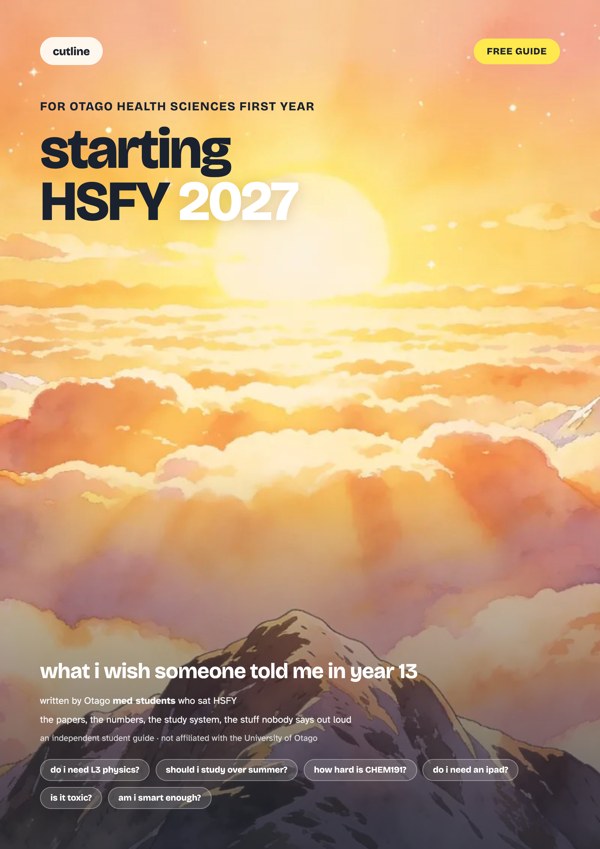
A look at the papers, entry pathways and what HSFY is like. Confirm your email and download your copy on the next page.
Join the free waitlist
Get Summer updates and a free HSFY guide. School exams first, start learning after you finish.