Skip to content
cutline

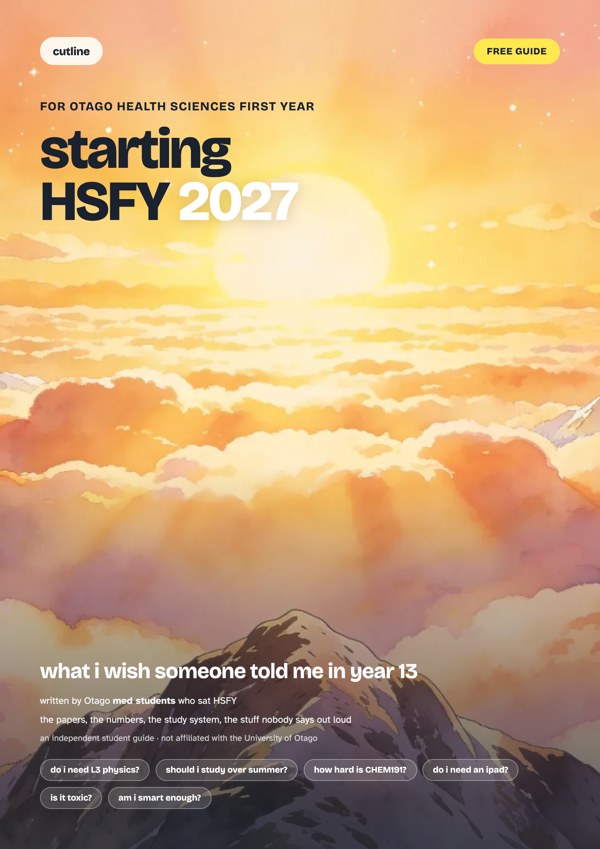
For University of Otago HSFY 2027

A head start on HSFY. A summer that’s still yours.

Walk into semester one already solid on the chemistry, physics and body systems basics, in short lessons you do at your own pace.

Apply freeNo payment today. Closes 25 October 2026.

Try a lesson first, if you would rather see it than read about it.

  • CHEM191(Chemistry), 11 modules
  • PHSI191(Physics), 9 modules
  • HUBS191(Human body systems), 9 modules
  • CELS191(Cell and molecular biology), 11 modules

HSFY moves fast from week one, and students without Year 13 chemistry or physics are starting from further back.

Summer is the one stretch with time to fix that. Physics, chemistry and the health science basics, at your own pace, built by University of Otago Medicine and Dentistry students.

Results you can check.

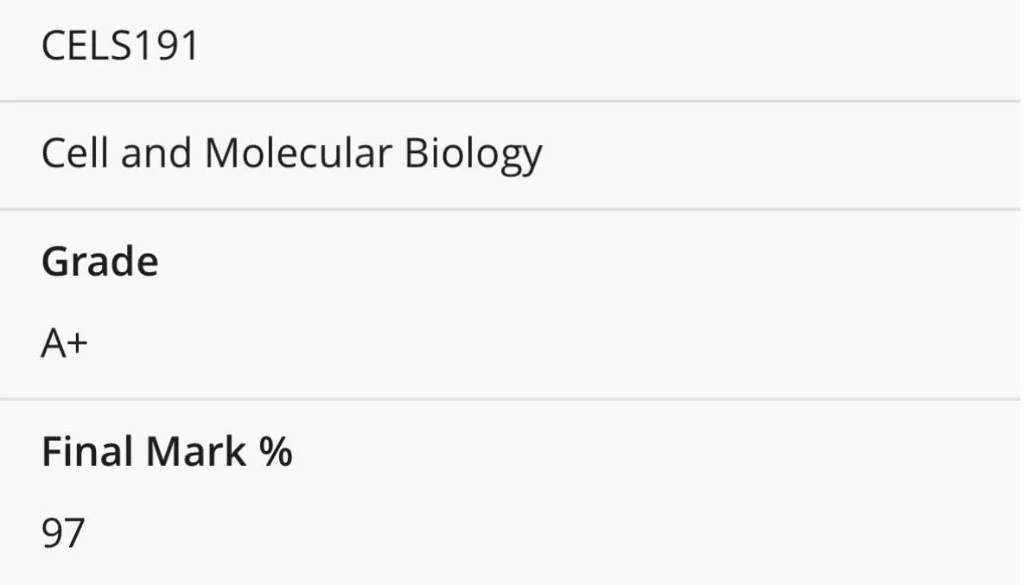
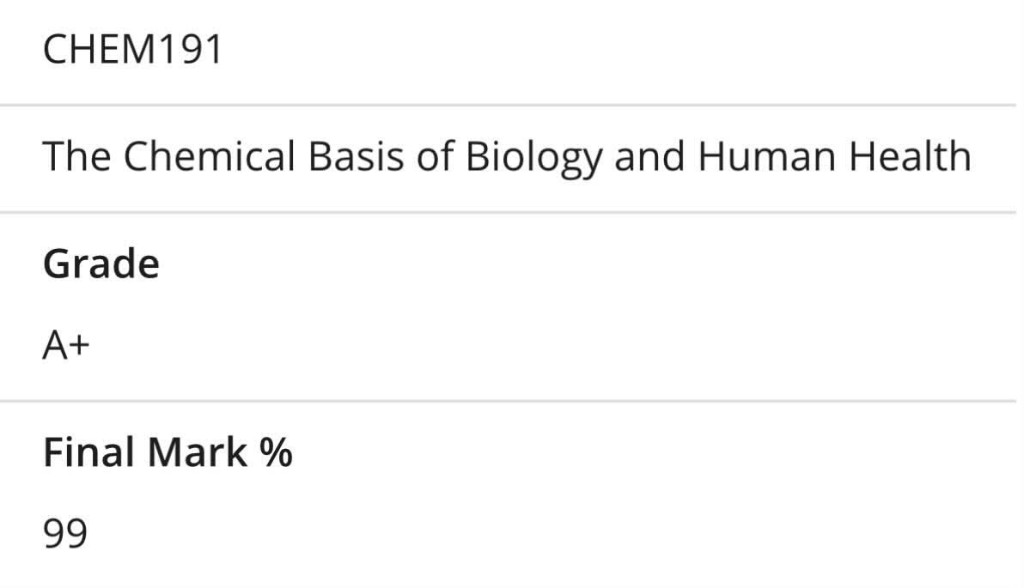
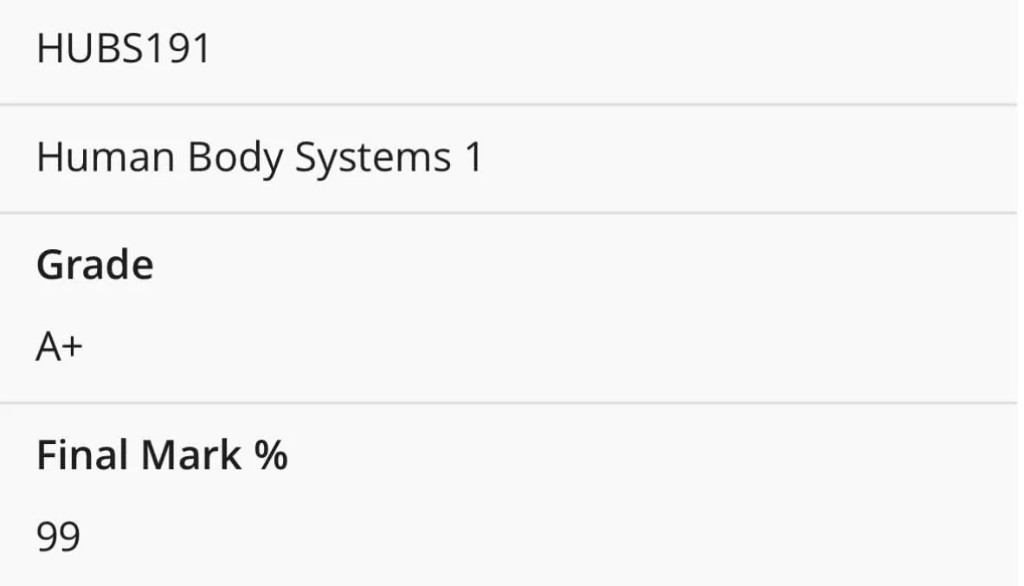
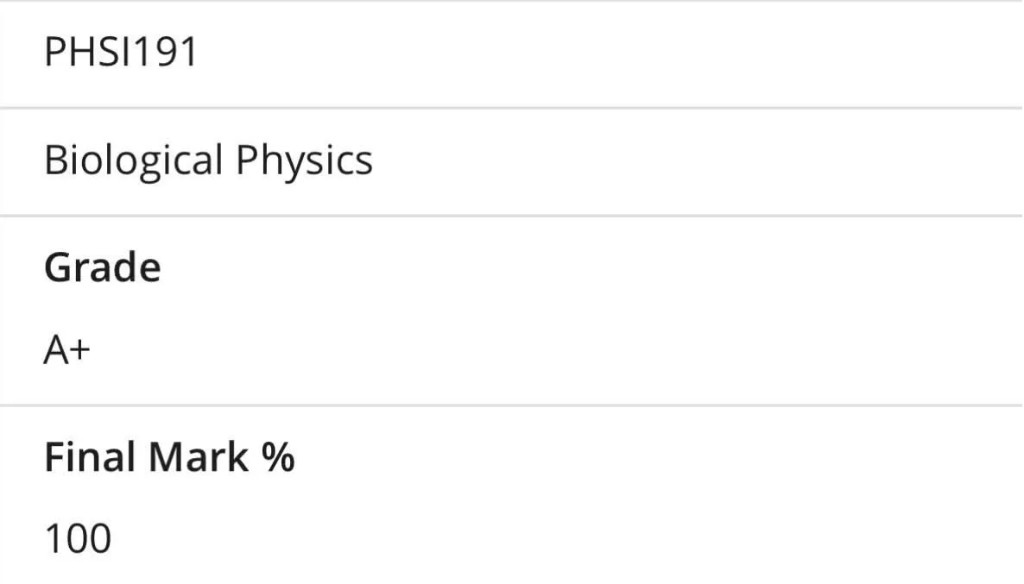
Semester one final marks of four Cutline students, from eVision, the University of Otago’s records system, shared with their permission.

CELS191 final mark, A+ · 97, cropped from eVision
CELS191A+ 97
CHEM191 final mark, A+ · 99, cropped from eVision
CHEM191A+ 99
HUBS191 final mark, A+ · 99, cropped from eVision
HUBS191A+ 99
PHSI191 final mark, A+ · 100, cropped from eVision
PHSI191A+ 100
800+HSFY students helped in 2026. Built by University of Otago Medicine and Dentistry students.

Individual results from the in-year Cutline app. Not typical, not a promise. Cutline Summer is new and has no results yet.

Three steps, and the first one is free.

  1. Apply free in 2 minutes

    Name, email and a plan. Nothing to pay today. The first round closes 25 October 2026.

  2. Get your offer on 2 Nov and pick a plan

    Offers are released and enrolment opens on 2 November 2026. You pay then, not before.

  3. Start any time after your last exam

    Platform access runs 16 November 2026 to 28 February 2027. Start after your last school exam.

Understand the concepts. Use them in the exam.

Exam-style questions for the semester one papers, with tutors showing you how. This preview is from the Summer beta.

From understanding to answering.

  1. Start with a realistic questionAn exam-style question, in context.
  2. See how to solve itA tutor walks you through it, step by step.
  3. Understand the methodWalkthroughs and interactive explanations show why it works.

And a study system to take into the year. Active recall, spaced repetition and a weekly study rhythm.

Lesson previewFrom the Summer beta

Forces in balance

A crate moves right across a level floor at constant velocity. A horizontal pull of 45 N acts to the right. What is the friction force? The pull and friction are the only horizontal forces.

Find the friction forceA crate on a level floor moves to the right at constant velocity. A horizontal pull points right and friction points left. Only horizontal forces are shown. The final diagram shows equal force arrows, each 45 N.
0:340:34Silent preview
Your tutor talks you through it

In the full lesson videos, your tutor explains each step out loud, so you can follow the method as well as the working.

Try it yourselfWhat friction force balances the 45 N pull to the right?

What each paper covers.

Planned Cutline Summer modules for the four semester one papers. Lecture counts overlap between modules.

CHEM 191, The chemical basis of biology and human health

Start with symbols and moles, then connect reactions, molecular structure and biological chemistry.

How to prepare for CHEM 191 over summer

How you’ll learn

Tutors will teach you how to solve realistic chemistry exam-style questions, explaining the calculations and chemical reasoning step by step.

Modules in this paper

  1. Module 1, topics from 10 lecturesHeadstart

    Concepts you’ll cover: Atoms, isotopes, electron shells, bonding and naming, Lewis structures, polarity and intermolecular forces, then formulae, units, equation balancing, moles, limiting reactants, concentration and logarithms.

    Practise for the exam: Use a balanced equation to identify the limiting reactant and calculate the product amount.

  2. Module 2, topics from 5 lecturesWater, solutions and equilibrium

    Concepts you’ll cover: Hydrogen bonding, solubility, electrolytes, reaction quotients, equilibrium calculations, changing mixtures and precipitation.

    Practise for the exam: Compare the reaction quotient with the equilibrium constant to predict how a mixture changes.

  3. Module 3, topics from 5 lecturesAcids, bases and buffers

    Concepts you’ll cover: Conjugate pairs, pH, strong and weak acids, buffers, titration curves and molecular ionisation.

    Practise for the exam: Choose an acid-base model and calculate pH from the information in the question.

  4. Module 4, topics from 3 lecturesEnergy and equilibrium

    Concepts you’ll cover: Heat, enthalpy, Hess’s law, entropy, Gibbs energy, temperature, reaction coupling and equilibrium constants.

    Practise for the exam: Use Gibbs energy to judge reaction direction under the stated conditions.

  5. Module 5, topics from 4 lecturesReaction rates

    Concepts you’ll cover: Rate laws, initial rates, first-order reactions, half-life, reaction mechanisms, activation energy and temperature.

    Practise for the exam: Infer a rate law from experimental data and explain how temperature affects the rate.

  6. Module 6, topics from 5 lecturesRedox and coordination

    Concepts you’ll cover: Oxidation states, half-equations, electrochemical cells, electrode potentials, membrane potentials, metal ions and biological electron transfer.

    Practise for the exam: Balance a redox reaction and use electrode potentials to judge its direction.

  7. Module 7, topics from 7 lecturesMolecular structure

    Concepts you’ll cover: Orbitals, Lewis structures, formal charge, resonance, molecular shape, functional groups, isomers and stereochemistry.

    Practise for the exam: Draw a Lewis structure and justify formal charges, molecular shape or an isomer assignment.

  8. Module 8, topics from 4 lecturesOrganic reaction mechanisms

    Concepts you’ll cover: Electron movement, nucleophiles, bases, leaving groups, substitution, elimination and addition reactions of alkenes.

    Practise for the exam: Follow electron movement to predict a product and justify the reaction mechanism.

  9. Module 9, topics from 6 lecturesCarbonyls and carbohydrates

    Concepts you’ll cover: Alcohols, amines, carbonyl reactions, imines, acetals, sugar rings, reducing sugars, glycosidic bonds and polysaccharides.

    Practise for the exam: Read a sugar structure and identify whether it has a reducing end.

  10. Module 10, topics from 7 lecturesLipids, amino acids and proteins

    Concepts you’ll cover: Carboxylic acid derivatives, esters, lipids, amino acid charge, peptides, protein structure and protease action.

    Practise for the exam: Determine an amino acid’s charge at a stated pH and explain your reasoning.

  11. Module 11, topics from 2 lecturesAromatic compounds and nucleic acids

    Concepts you’ll cover: Aromatic rings, heterocycles, nucleosides, nucleotides, phosphate bonds, base pairing and nucleic-acid stability.

    Practise for the exam: Use molecular structure to explain base pairing and the stability of a nucleic acid.


Build a method you can take into the exam. Recognise the concept, choose a method, explain your answer, even when the question looks unfamiliar.

Pick your start.

One free application for every option. You pay from 2 November 2026, after an offer, and only if you accept it.

Summer Mentor Circle, 50 places

Summer + Cutline HSFY 2027 + Summer Mentor Circle

NZ$1,949or $650 + $650 + $649

Everything in Summer + Cutline HSFY 2027, with a small group and someone checking in. Chosen on suitability from the application, not first-come.

  • A named mentor, an Otago med or dent student
  • Six weekly small-group sessions, at most 10 students, in English, Nov to Feb
  • Two 1:1 check-ins
  • By application: mentoring offers expire 9 November 2026
Apply for the Mentor Circle

HSFY Head Start Accelerator

Cutline Summer

NZ$699or 3 x $233

15 weeks, 16 Nov to 28 Feb. CHEM, PHSI, CELS and HUBS basics before day one.

  • Short lessons and practice
  • Beginner chemistry and physics routes
  • Weekly Q&A
  • Add 2027 later for NZ$850, before 28 February 2027
Apply for Cutline Summer

The first module guarantee

Do the first module of each paper by 31 December 2026. If Summer isn't helping, tell us and get a full refund.

Plus a full refund within 14 days of paying, no questions. GST included. Three payments, 30 days apart, that stop after the third. Mentor Circle sessions already held are not refunded.

Med or dent? Add UCAT ($199) or the Dent interview ($99) during HSFY.

Next to what the year costs

Tuition for a full-time year of Health Sciences papers (2026 rates)NZ$10,159
A standard room in a University residential college (2026 contract)NZ$21,470
The year, by Otago’s own figuresNZ$31,629
Cutline SummerNZ$699

Cutline Summer is about 2% of what the year itself costs.

Both figures are the University of Otago’s own, from its tuition fees page and its college fee schedule.

Dates to know

First application round closes
25 October 2026, end of day NZ time
Enrolment opens
2 November 2026
Mentoring offers expire
9 November 2026
Summer access
16 November 2026 to 28 February 2027

Is a parent paying?

Send them the parent page, in English and 中文.

cutline.nz/parents

Your online classroom for summer.

Your pace. Tutors walk you through exam-style questions.

Open your online classroom.

Short lessons, practice and worked answers in one place.

Learn around your summer.

A lesson whenever it suits you. Start any time after your last school exam.

See how to solve it.

Tutors explain the method. Ask when you get stuck.

From the people behind Cutline. Cutline is built by Otago medicine and dentistry students who sat these papers themselves.

Information for parents

A few things you might be wondering.

Do I need school chemistry or physics?

No. Beginner routes start from zero; a faster route starts at HSFY level.

Can I fit it around holidays and work?

Yes. It is self-paced and the weekly Q&A is optional. The Summer Mentor Circle (Nov to Feb only) adds six weekly sessions.

What support is included?

Questions answered on the platform and a weekly Q&A. The Summer Mentor Circle adds small-group sessions, Nov to Feb only, with Otago Medicine and Dentistry students who got exceptionally high grades in HSFY.

Which one should I pick?

Summer + Cutline HSFY 2027 if you start HSFY in 2027. Cutline Summer for the summer only. Want a small group? Ask for the Summer Mentor Circle on the form.

When does it run?

Applications close 25 October 2026. Enrolment opens 2 November 2026. Access runs 16 November 2026 to 28 February 2027.

Can I change my mind?

Yes. Full refund within fourteen days of paying.

Is mentoring available in Chinese?

No, mentoring is in English. The platform and the guides are in English and Chinese.

What happens after summer?

Summer + Cutline HSFY 2027 carries on in the Cutline app to 1 December 2027. On Cutline Summer? Add 2027 for $850 before 28 February 2027.

Is Cutline Summer part of the University of Otago?

No. Cutline operates independently and is not affiliated with, employed by, or endorsed by the University of Otago.

Apply for Cutline Summer.

Free application. No payment today. Name, email and a plan. The rest is optional, after you confirm.

First round closes 25 October 2026. Offers from 2 November 2026. A person reads every application, and you hear back by email either way.

Free application. No payment today.

Open the application

Not ready to apply yet?

Get the free HSFY plan and guide. Seven taps for your read, the free HSFY guide and Summer updates.

Build your free HSFY plan

Your free read

1 of 7

What are you hoping to get into after HSFY?

Cutline operates independently and is not affiliated with, employed by, or endorsed by the University of Otago.

Cutline Summer: HSFY preparation, November to February | Cutline