
Skip to content
cutline

UCAT PlaybookChapter 3 of 8

Quantitative Reasoning

The maths is Year 10. The test is the reading and the clock. Plenty of marks go before the first key is pressed, on the question of what to divide by what.

questions
36questions
minutes
26minutes
each, about
43 seach, about

Three things before you type

Find the base

A percentage is always a percentage of something. Point at the row or column that is the of before you divide. Writing the base on the noteboard takes two seconds.

Read the units and the title

Thousands, per cent, per month, per 100 people. The table’s title and the column headers tell you what the numbers mean. The answers are often the same digits in different units.

Estimate first

Round the numbers and say roughly what the answer should be. If the options are far apart, the estimate is the answer and the calculator never opens. If they are close, the estimate catches a slip.

January240February270+30the base30 / 240 = 12.5%not 30 / 270

The calculator, and when not to use it

The on screen calculator is a basic one. It does one sum at a time, so a long chain is easy to lose.

Alt + C opens it, and the number keys work if Num Lock is on. Backspace wipes the whole number, not one digit, and the calculator stops listening when you click back on the question, so click it again before you type.

Do the arithmetic you can do in your head in your head. Halves, tenths and doubling are faster than any calculator. Save the keys for awkward divisions and long multiplications.

With 43 seconds a question, some questions are not worth it. A four step chain with a messy division can take two minutes. Flag it, guess, and come back if time is left. Chapter 5 shows how.

43 sa question, on average

Four traps, and how to dodge them

Each one has a name, an example and a fix. The tables are made up for this page.

Wrong baseDivided by the wrong number.

A fictional gym had 160 members in March and 200 members in April.

By what percentage did membership increase from March to April?

  • A20%the trap pickTrap
  • B25%the right answerRight
  • C40%
  • D125%

An increase is measured against where it started. The change is 40, and the base is March’s 160, so 40 divided by 160 is 25%. Dividing by 200 gives 20%, the fall you would need to go back down.

FixName the reference quantity before you divide. For an increase, it is the earlier number.
Of versus more thanA percentage of was read as a percentage more than.

In a fictional school, 80 students take Biology. The number taking Chemistry is 25% more than the number taking Biology.

How many students take Chemistry?

  • A20the trap pickTrap
  • B60
  • C100the right answerRight
  • D105

25% of 80 is 20. But the question says 25% more than 80, which is 80 plus 20, so 100. The small word changes the answer by a factor of five.

FixOf means a part. More than means the whole thing plus a part. Circle the word before you work.

Stopped earlyA middle number was taken as the answer.

A fictional bakery sells 150 loaves a day. 40% are sourdough. Each sourdough loaf uses 0.8 kg of flour.

How much flour goes into the sourdough loaves in a day?

  • A40 kg
  • B48 kgthe right answerRight
  • C60 kgthe trap pickTrap
  • D120 kg

40% of 150 is 60 loaves. That is a step, not the answer, and the options reward stopping there. 60 loaves times 0.8 kg is 48 kg.

FixBefore you click, reread the last five words of the question. Check the unit of your answer matches the unit it asks for.

Wrong statisticThe mean, median or range was mixed up.

Five fictional swimmers record these times in seconds: 31, 28, 35, 28, 48.

What is the median time?

  • A28
  • B31the right answerRight
  • C34the trap pickTrap
  • D20

The median is the middle value once the list is in order: 28, 28, 31, 35, 48, so 31. The mean is 34, the mode is 28 and the range is 20. All four are in the options.

FixUnderline the statistic word in the question and say what it means before you touch the numbers. Median means sort first.

Try one

One table, four questions. Decide the base before the calculator.

Set 1

02:52

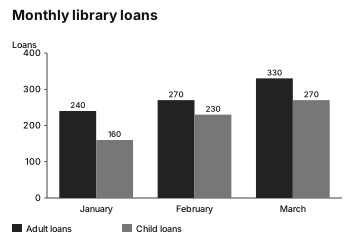
A fictional community library records loans in three months. Adult and child loans are separate counts.

march adult renewal rate: 20 %

march child renewal rate: 30 %

march open days: 20 days

The March renewal rates are the shares of loans in each group that were renewals.

Grouped bars showing adult and child loan counts in January, February and March

Question 1

What percentage of January loans were child loans?

Choose an answer

Question 2

By what percentage did adult loans increase from January to February?

Choose an answer

Question 3

What percentage of all March loans were renewals, when the adult and child renewal rates are applied to their respective loan counts?

Choose an answer

Question 4

In March, how many loans were recorded per open day, to the nearest whole loan?

Choose an answer

The trap method for Quantitative Reasoning

1

Name the trap

For every miss, pick which of the 4 above caught you. Never careless. The name.

Wrong base
2

Write your rule

One line, in your words, that would have saved you. Keep it on one sheet.

Point at the of before I divide.

3

Dodge it three times

On new questions. When it has not caught you three times running, cross it off.

Retired

The whole method, in chapter 7

In Cutline UCAT this happens on its own: almost every miss gets its trap, the Train tab says Fix wrong base, and the trap retires after three clean, in-time dodges.

Start practising free

Get the Playbook by email

The link to every chapter, in your inbox, for when you come back to it.

One tap in the email to confirm. If you do not confirm, we keep your address for up to 7 days to send two reminders, then delete it.

Quantitative Reasoning: UCAT Playbook chapter 3 | Cutline